Quick answer
To teach kids about biology with puzzles and games, start by choosing age-appropriate, science-accurate resources that match their interests. Then, create a structured yet playful learning routine that combines hands-on activities with discussion and real-world connections.
Kids are naturally curious about living things, from the tiniest insects to the workings of their own bodies. Puzzles and games tap into that curiosity by making abstract biological concepts tangible and fun. Instead of memorizing facts from a textbook, children can assemble a heart, identify organs, or race to match elements—all while absorbing real science.
In this guide, you'll find a practical, step-by-step approach to using biology-themed puzzles and games at home or in the classroom. We'll cover how to pick the right resources, how to introduce them effectively, and how to keep the learning going long after the game is over.
Why Puzzles and Games Work for Biology Education
Biology is a visual and structural science. Understanding how the heart pumps or how the hand moves requires a mental picture of anatomy and function. Puzzles provide that picture in a hands-on way. When a child fits a piece shaped like a heart valve or a bone, they're not just completing a picture—they're internalizing spatial relationships and anatomical names.
Games add motivation and repetition. A child who won't sit still for a flashcard session will happily play a biology game for thirty minutes. Cooperative games, in particular, encourage discussion and peer teaching, which reinforces understanding. The key is to choose resources that are scientifically accurate and appropriately challenging for the child's age.
- Look for puzzles and games that are designed with input from educators or scientists to ensure accuracy.
Choosing the Right Biology Puzzle or Game for Your Child
Age is the first consideration. For younger children (ages 4-7), look for large-piece floor puzzles with bright, simple illustrations of animals or plants. For older kids (ages 8-12), consider more detailed puzzles and strategy games that introduce terminology and systems. The product's age rating is a helpful starting point, but also think about your child's reading level and attention span.
Next, think about your child's interests. If they love animals, a shark puzzle might be more engaging than a human anatomy puzzle. If they're fascinated by how their body works, a heart or eye puzzle could spark deeper questions. Matching the topic to their passion ensures they stay motivated. Also, consider the format: puzzles are solitary or small-group activities, while games are inherently social. Choose based on whether you want independent exploration or family interaction.
- Check the piece count and complexity: a 500-piece puzzle may frustrate a beginner, while a 100-piece puzzle might bore an advanced child.
Setting Up a Biology Learning Session
Create a dedicated space where you can leave a puzzle or game set up for multiple sessions. This allows children to return to it over several days, deepening their learning. A large table or a puzzle mat works well. Ensure good lighting and comfortable seating.
Before starting, introduce the topic with a brief conversation. Ask questions like, 'What do you already know about the heart?' or 'What parts of a shark do you think we'll see?' This activates prior knowledge and sets a purpose for the activity. Then, explain the rules of the game or the goal of the puzzle, and let the child take the lead as much as possible.
- Use the included anatomy guides or fact sheets to discuss each part as it's placed or played.
Integrating Puzzles and Games into a Broader Biology Curriculum
Puzzles and games shouldn't be isolated activities. Connect them to other learning opportunities. For example, after completing a heart puzzle, read a picture book about circulation or watch a short video of a real heart beating. After playing a game about fractions, discuss how fractions appear in nature, like in the spiral of a shell or the divisions of a flower.
Encourage children to ask their own questions. 'Why is the heart on the left?' or 'How do sharks breathe?' Use the puzzle or game as a springboard for research projects or simple experiments. This transforms a one-time activity into an ongoing exploration.
- Keep a 'biology journal' where kids can draw what they learned and write down questions for future sessions.
Step-by-Step Guide to Teaching Biology with Puzzles and Games
- Assess your child's age and interests: Choose puzzles or games that are age-appropriate and align with what your child already loves. For example, a 6-year-old might enjoy a shark floor puzzle, while a 10-year-old might be ready for a detailed heart puzzle. Checkpoint: Is the difficulty level right? If your child is frustrated or bored, adjust the piece count or game complexity.
- Introduce the topic with a conversation: Before opening the box, ask open-ended questions to spark curiosity. For a heart puzzle, you might ask, 'Why do you think the heart has four chambers?' For a shark puzzle, 'What do you know about shark teeth?' Checkpoint: Did your child ask any questions? If not, prompt with a fact from the included guide.
- Work on the puzzle or play the game together: For puzzles, start by sorting edge pieces and working inward. Use the anatomy guide to name parts as you place them. For games, read the rules aloud and play the first round cooperatively if possible. Checkpoint: Are you both having fun? If the activity feels like a chore, take a break and return later.
- Discuss what was learned: After completing the puzzle or game, review the key concepts. Ask your child to explain what they learned in their own words. Connect the new knowledge to everyday life, like pointing out their own pulse or the structure of a fish at the aquarium. Checkpoint: Can your child name at least three parts or concepts from the activity? If not, revisit the guide together.
- Extend the learning with related activities: Plan a follow-up activity, such as drawing the organ, watching a short documentary, or visiting a science museum. This reinforces the information and shows how biology applies to the real world. Checkpoint: Have you scheduled a follow-up? Even a simple 'Let's find more about this' conversation keeps the learning alive.
Recommended Products for Teaching Biology
- Human Heart Anatomy Jigsaw Puzzle | Dr. Livingston's Unique Shaped Science Puzzles: Assemble the human heart at 600% magnification! Each piece is custom cut. Illustrated by Mesa Schumacher, a Certified Medical Illustrator from Johns Hopkins University. 597 pieces. This puzzle offers a detailed, scientifically accurate look at the heart's anatomy, making it perfect for older kids who want to understand how the heart works. The custom-cut pieces highlight real anatomical shapes, reinforcing learning through touch.
- Human Eye Anatomy Jigsaw Puzzle | Dr. Livingston's Unique Shaped Science Puzzles: Themes: Human Anatomy, Human Eye, Cornea, Iris, Pupil, Retina, Macula, Optical Nerve. Material: Cardboard, Die-Cut to Highlight Real Anatomy. Pieces: 544. Illustrated by Mesa Schumacher, a Certified Medical Illustrator from Johns Hopkins University. This puzzle is excellent for teaching the structure of the eye. The die-cut pieces follow the actual contours of the eye's anatomy, helping children visualize how parts like the retina and cornea fit together. It's a great follow-up to a biology lesson on vision.
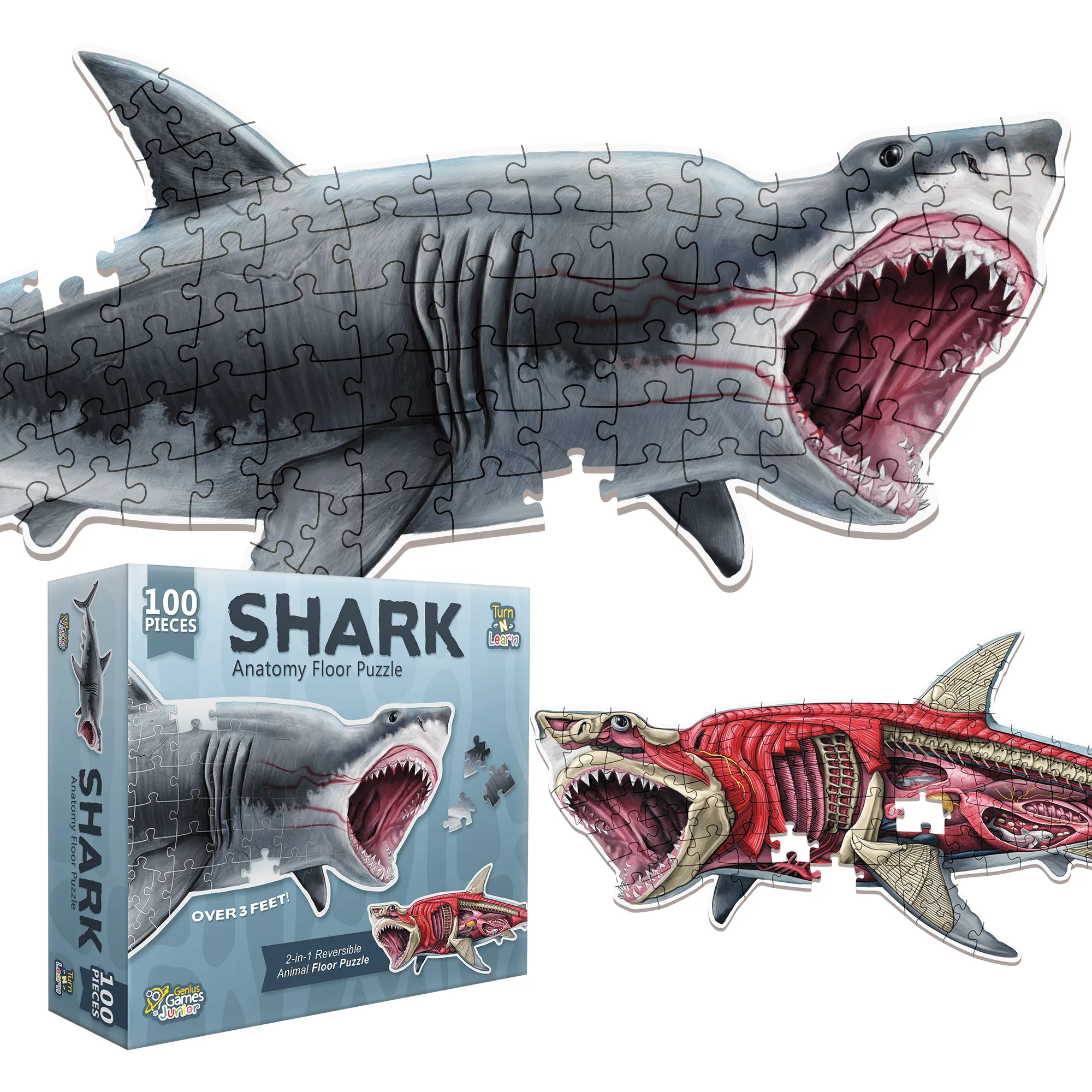
- Shark Jigsaw Puzzle - 4FT Double Sided Floor Puzzle: A 100-Piece Scientifically Accurate Turn N Learn Educational Puzzle for Kids! Includes: Double Sided Puzzle (Inside and Outside of a Shark) Anatomy Guide Fact Sheet. Snap together the supreme predatory fish with this Great White Shark puzzle. For younger kids or those fascinated by ocean life, this floor puzzle shows both the external features and internal anatomy of a shark. The double-sided design and included fact sheet make it an interactive learning tool that encourages discussion about marine biology.
Teaching biology with puzzles and games turns passive learning into an active, memorable experience. By choosing the right resources, guiding the activity, and extending the conversation, you can help your child develop a lasting fascination with life science. The key is to keep it playful, exploratory, and connected to their world.