Quick answer
Match your camera's thread to the telescope-side thread first, then add spacers to hit the required back focus. Measure both thread diameters with calipers rather than guessing, and buy an adapter that states its gender and pitch. If you already own a QSI WSG camera, the STL Thread Adapter for QSI WSG Cameras (TCD0774) solves the STL-to-QSI spacer connection directly.
Thread standards you will actually encounter
Astrophotography uses a handful of thread standards, and mixing them up is the fastest way to stall a build. M42 (also called T-thread) is 42 mm x 0.75 mm pitch. M48 is 48 mm x 0.75 mm and is common on full-frame correctors and many focusers. M54 is 54 mm x 0.75 mm and appears on larger imaging circles, dedicated astro cameras, and filter wheels. The numbers refer to the outside diameter of the male thread; pitch is the distance between thread crests. Two adapters can both be 'M48' but differ in pitch, so check the full callout, not just the diameter.
- M42 x 0.75: classic T-thread, still used on many DSLR T-rings and small cameras.
- M48 x 0.75: wide enough to reduce vignetting on APS-C and full-frame sensors.
- M54 x 0.75: increasingly common on dedicated astro cameras and filter wheels.
- STL: a larger thread used on some Takahashi and QSI camera systems; not interchangeable with M48 or M54.
Back focus is a distance, not a thread
Back focus is the distance from a reference surface (often the rear flange of a corrector or flattener) to the camera sensor. Adapters and extension tubes consume part of that distance. If your camera needs 55 mm of back focus and the corrector provides 55 mm, you need the optical path through your adapters and any filter wheel to equal that number. Filters shift focus slightly, and thick adapter flanges add up. Measure the optical thickness of each component, not the mechanical length from thread tip to thread tip. When a manufacturer does not publish a specification, treat it as unknown and measure it yourself or ask before buying.
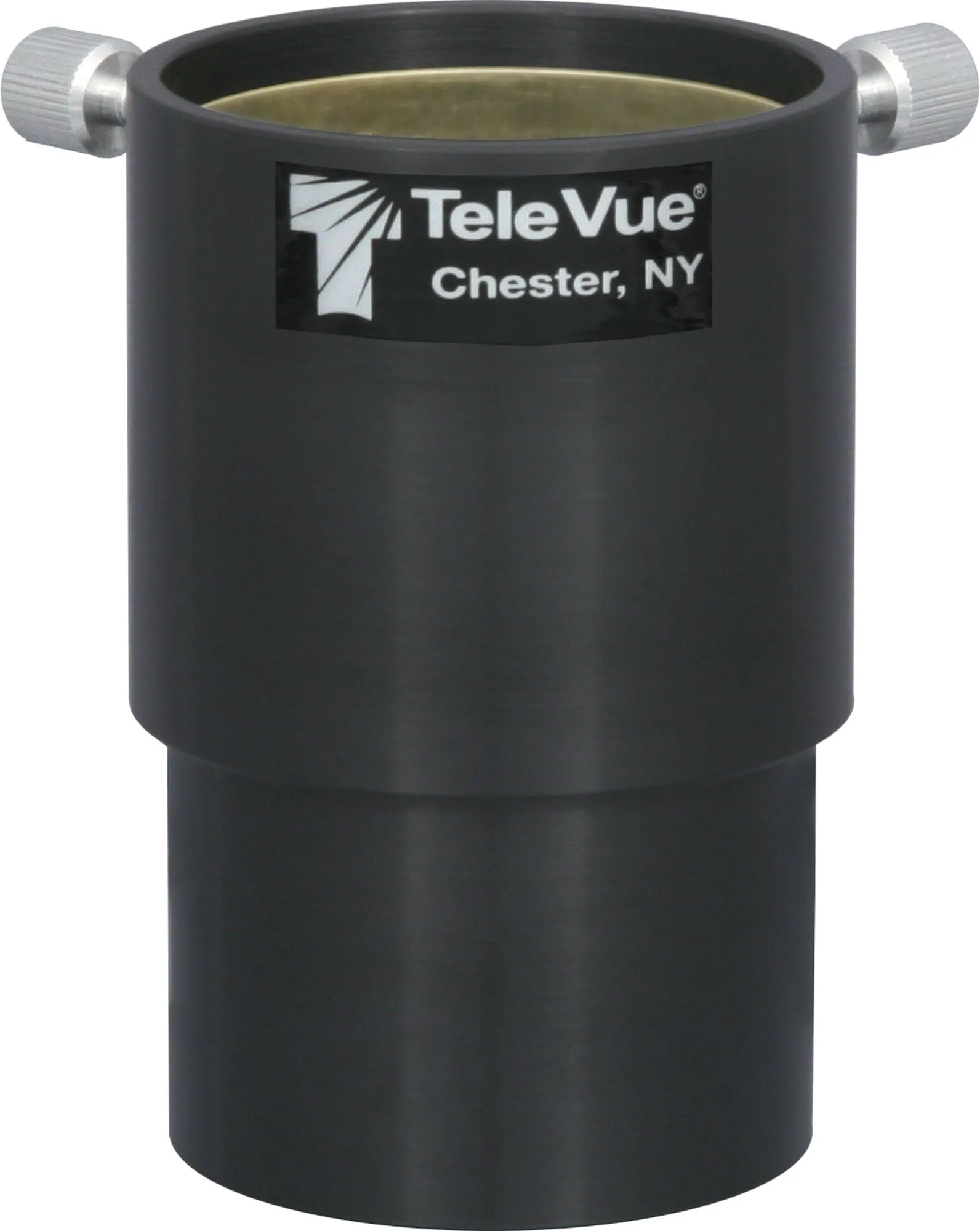
extension tubes
- Add up camera flange distance, filter wheel thickness, and adapter optical length.
- Remember that a filter adds roughly one-third of its thickness to the optical path.
- If the total is short, add a spacer; if long, look for a thinner adapter.
How to measure and verify before you buy
Use calipers to measure the outside diameter of the male thread you need to mate with. Measure the pitch if you can, or compare against a known thread gauge. Check the gender: some adapters have male threads on both sides, some female on both sides, and some are male-to-female. Look at the drawing or photo carefully. If the listing shows only a name like 'M54 adapter' without pitch or gender, ask the seller. Return shipping on a wrong adapter often costs more than the adapter itself.
- Measure the male thread outside diameter with calipers.
- Confirm pitch (usually 0.75 mm for M42, M48, and M54).
- Check gender on both ends: male, female, or one of each.
- Verify optical length if back focus is tight.
Spacers and extension tubes: when to use them
Spacers, also called extension tubes, add fixed distance between two threaded components. They are the correct tool when your imaging train is short of the required back focus. Buy a set with several lengths so you can fine-tune rather than ordering one custom tube. Thin spacers (1 mm, 2 mm) are useful for the final adjustment. Avoid stacking many thin spacers if you can use one longer tube; each threaded joint is a potential tilt or light-leak point. If you need variable spacing, a helical focuser or adjustable spacer works, but it adds a failure point and cost.
- Use spacers to add distance, not to change thread size.
- Prefer one longer spacer over several short ones when possible.
- Keep a few 1 mm and 2 mm shims for final back focus tuning.
Common mismatches and how to avoid them
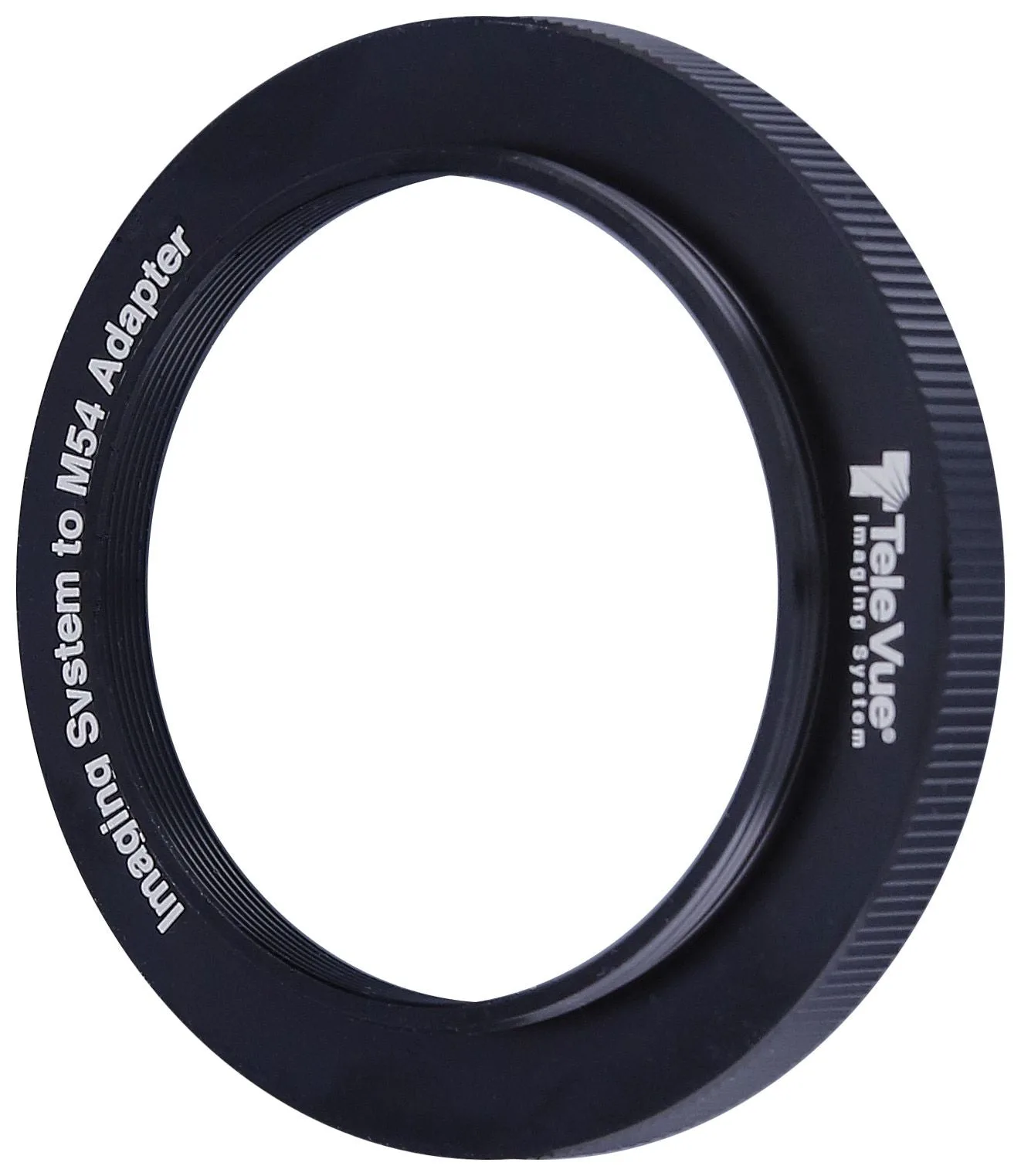
The most frequent error is assuming M48 and M54 are interchangeable because both use 0.75 mm pitch. They are not; the diameters differ by 6 mm. Another is buying a T-thread (M42) adapter for a camera that actually uses M48. Some cameras have a proprietary bayonet or a thread that looks like M42 but has a different pitch. If you are adapting a QSI WSG camera to an STL-threaded accessory, use a dedicated adapter rather than stacking generic rings. For Tele Vue Imaging System accessories, the M54 Camera Adapter for Tele Vue 2.4" Imaging System (M54-1073) provides male M54 x 0.75 mm threads on one side and the Imaging System female threads on the other, which lets you integrate M54 hardware without custom machining.
- Do not force a thread; if it binds after a quarter turn, stop.
- Check whether your camera uses M42, M48, M54, or a proprietary mount.
- Use a dedicated adapter when crossing between thread families.
Decision rules for matching adapters and spacers
- Match the camera thread first: Identify your camera's native thread (M42, M48, M54, or proprietary) before choosing any adapter. The telescope side can be adapted later. Write down the camera thread callout and keep it with your gear list.
- Then match the telescope or corrector side: Check the thread on the focuser drawtube, flattener, or corrector. If it differs from the camera thread, you need an adapter that converts between the two. If both sides are the same thread, you may only need a spacer, not an adapter.
- Calculate back focus before buying spacers: Add the optical length of every component between the reference surface and the sensor. Compare with the manufacturer's required back focus. If the total is short, buy a spacer set; if long, look for a thinner adapter or remove a component.
- Prefer dedicated adapters over stacked rings: Each threaded joint adds potential tilt and light leaks. A single adapter made for the two threads you are joining is more reliable than two or three generic rings. If you cannot find a dedicated adapter, keep the stack as short as possible.
- Verify gender and pitch before ordering: Male-to-male, female-to-female, and male-to-female adapters all exist. Pitch is usually 0.75 mm for M42, M48, and M54, but confirm it. When the listing is ambiguous, ask the seller for a dimensioned drawing.
Products that solve specific thread and spacing problems
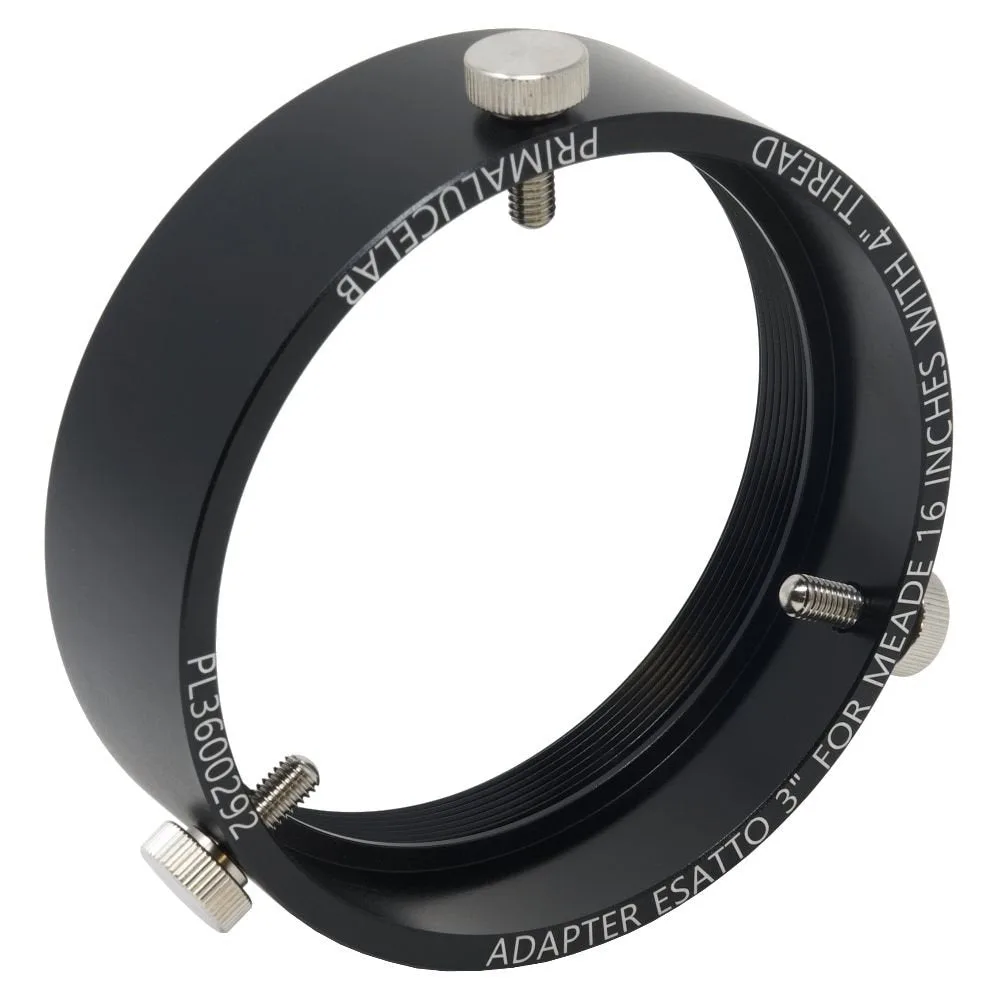
- Adapters for 3" ESATTO Microfocuser: À la carte telescope and camera adaptors for the 3" ESATTO Robotic Microfocuser. You can purchase a pair of camera and telescope adapters, only a camera adapter, or only a telescope adapter. To purchase only one or the other, choose the "None" option for the unneeded type. Lets you buy exactly the adapter you need for your ESATTO focuser instead of a full set you may not use.
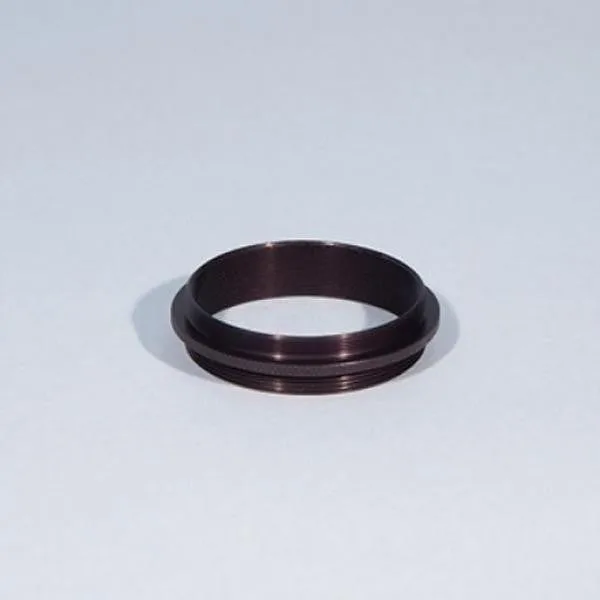
- STL Thread Adapter for QSI WSG Cameras (TCD0774): Takahashi STL Thread adapter designed for QSI WSG series cameras. Connects the QSI WSG series camera spacer to the STL thread. Solves the specific STL-to-QSI WSG connection without stacking generic adapters that may not match pitch or gender.
- M54 Camera Adapter for Tele Vue 2.4" Imaging System (M54-1073): The M54 thread is becoming popular on full-frame, dedicated astro-imaging cameras and filter wheels/holders. This M54 camera adapter has male M54 x 0.75mm threads on one side and Imaging System female threads on the other, allowing easy integration of M54 compatible hardware with Imaging System accessories. Provides a direct, correctly specified bridge between M54 cameras or filter wheels and Tele Vue Imaging System accessories.
- 1.25" Adapter (ADA125): The 1.25" adapter is included with focusers and refractors, but also offered as an accessory to use with any telescope. It slips into a 2" opening and is used for 1.25" accessories. It features a brass locking ring and is threaded for 48 mm filters. Note that if you use long-barreled eyepieces, such as TeleVue Radians, you may strike the filter; in this case, add a spacer. Useful when you need to step down from a 2-inch focuser to 1.25-inch accessories while keeping 48 mm filter threads available.
Is this approach right for you?
Best for
- Imagers who need to connect a camera with M42, M48, or M54 threads to a telescope or corrector with a different thread.
- Users who need to add a specific amount of back focus with spacers and want to avoid trial-and-error purchases.
- Owners of QSI WSG cameras who need to connect to STL-threaded accessories.
- Tele Vue Imaging System users who want to integrate M54 cameras or filter wheels.
Not for
- Visual observers who only use 1.25-inch or 2-inch eyepieces and do not need threaded camera connections.
- Imagers whose camera and telescope threads already match and who do not need to adjust back focus.
- Anyone unwilling to measure threads and optical lengths before buying; guessing leads to returns and wasted nights.