Two light recipes, one goal: weight management
If your dog needs to shed a few pounds, you're likely comparing light dog food options. MyPetSays offers two grain-free adult light recipes: one built on trout and salmon, the other on turkey. Both are low-fat formulas designed to help manage weight, and both include a joint care pack for overweight dogs. But they differ in protein source, fat level, calories, and added ingredients. This comparison breaks down the label facts so you can choose the recipe that best fits your dog's needs.
Always transition gradually and confirm portion sizes with your vet, as the packaging does not provide feeding amounts.
Side-by-side: trout vs turkey light recipes
- Crude protein: Trout recipe: 25%. Turkey recipe: 27%. The turkey recipe offers slightly more protein per 100g.
- Crude fat: Trout recipe: 8%. Turkey recipe: 9%. Both are low-fat, but the trout recipe is marginally lower in fat.
- Metabolisable energy: Trout recipe: 340 kcal/100g. Turkey recipe: 343 kcal/100g. The difference is small—about 3 kcal per 100g.
- Omega 3: Trout recipe: 4%. Turkey recipe: 1%. The trout recipe is notably higher in omega 3, which supports skin and coat condition and healthy joints.
- Omega 6: Trout recipe: 1.4%. Turkey recipe: 1.8%. The turkey recipe has slightly more omega 6.
- Calcium: Trout recipe: 1.1%. Turkey recipe: 1.5%. The turkey recipe provides more calcium.
- Phosphorus: Trout recipe: 0.9%. Turkey recipe: 1.1%. The turkey recipe provides more phosphorus.
Trout recipe: higher omega 3, slightly lower fat
-
Grain Free Adult Light Dog Food - Trout with Salmon, Sweet Potato & Asparagus: Crude Fat 8%, Omega 3 4%, Metabolisable Energy 340kcal/100g This recipe is the lower-fat, higher-omega-3 option, which may appeal if you want to support skin, coat, and joints alongside weight loss.
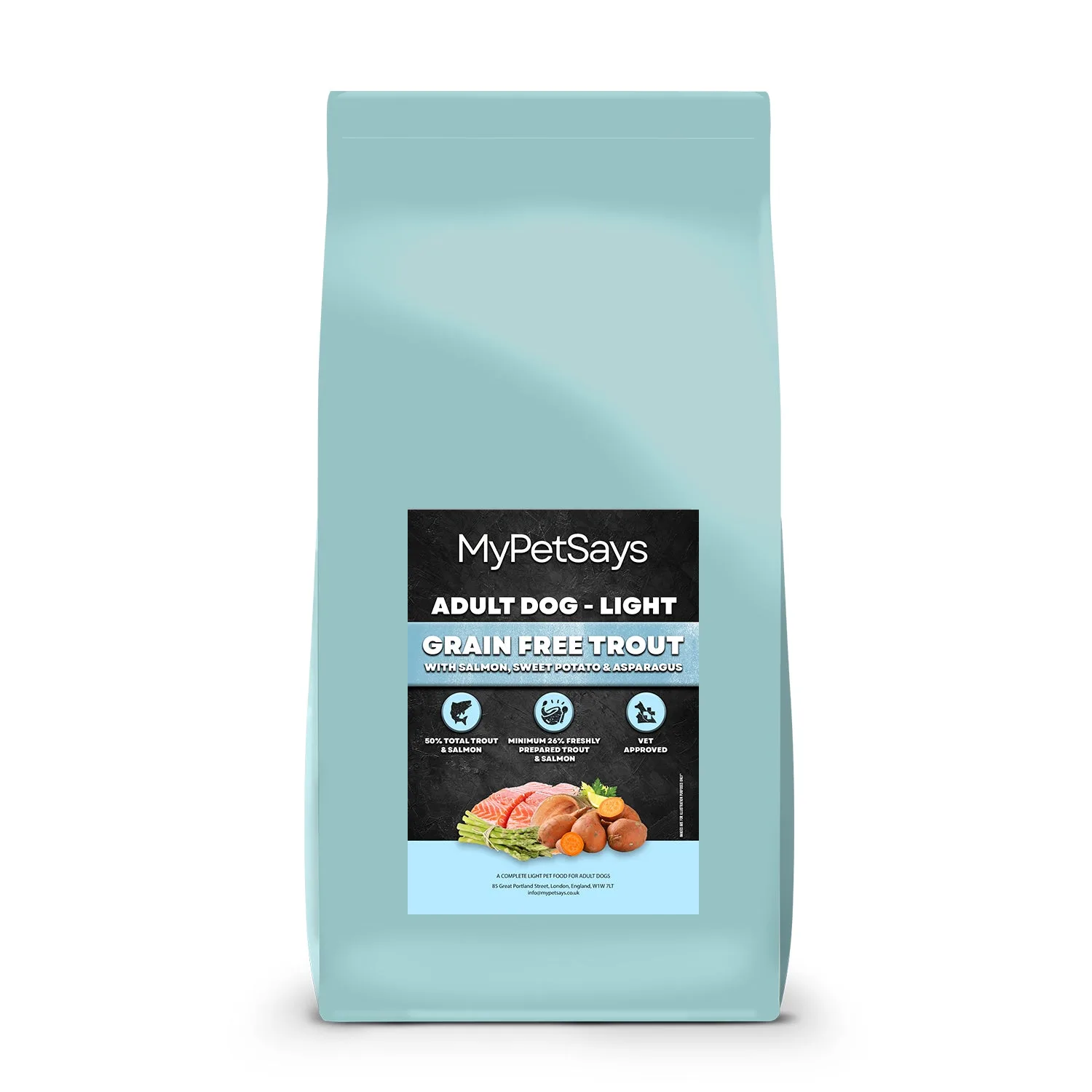
Grain Free Adult Light Dog Food - Trout with Salmon, Sweet Potato & Asparagus
-
Grain Free Adult Light Dog Food - Trout with Salmon, Sweet Potato & Asparagus: Made with Trout & Salmon 50% (including Freshly Prepared Trout 30%) and Asparagus (0.3%) Fish is the sole animal protein source, which can be useful for dogs that do better on fish-based diets or have sensitivities to other proteins.
Turkey recipe: slightly more protein and calcium
-
Grain Free Adult Light Dog Food - Turkey, Sweet Potato and Cranberry: Crude Protein 27%, Crude Fat 9%, Metabolisable Energy 343 kcal/100g This recipe offers a bit more protein and calories, which might suit dogs that need slightly more energy or protein to maintain lean mass during weight loss.
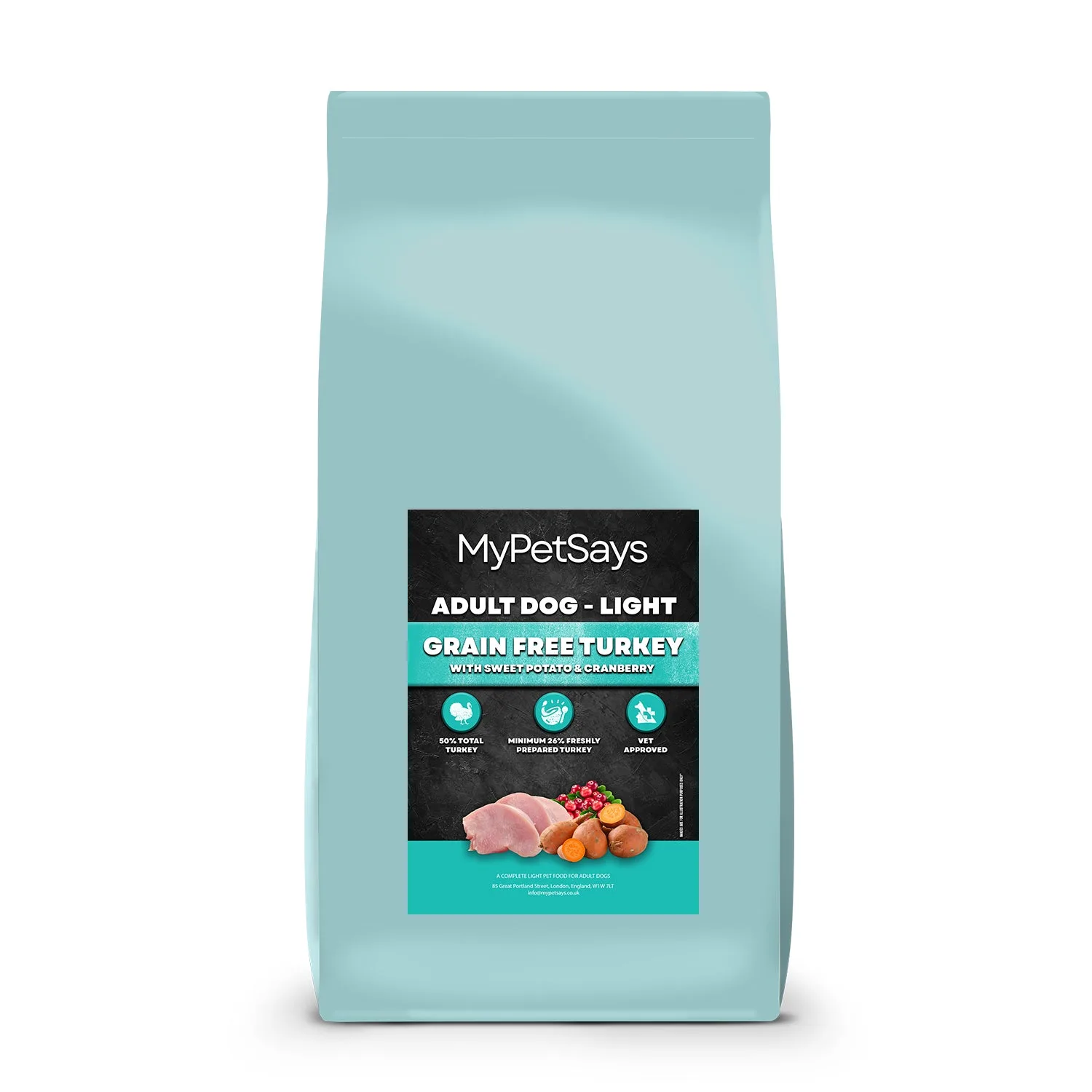
Grain Free Adult Light Dog Food - Turkey, Sweet Potato and Cranberry
-
Grain Free Adult Light Dog Food - Turkey, Sweet Potato and Cranberry: Made with Turkey 50% (including Freshly Prepared Turkey 27%) and Cranberry (0.2%) Turkey is a novel protein for some dogs, and cranberry adds vitamin C, E, and K plus dietary fibre.
What both recipes share
Both formulas are grain-free, using sweet potato and potato as carbohydrate sources, making them suitable for dogs with grain intolerance or sensitivity. They each contain a joint care pack with glucosamine (170 mg/kg), methylsulfonylmethane (170 mg/kg), and chondroitin sulphate (125 mg/kg) to support cartilage in overweight dogs. Neither contains added artificial colours or preservatives; they are naturally preserved with rosemary extract. Both include added L-carnitine to help maintain a healthy weight and lean muscle mass. Available sizes are 6kg, 12kg, and 24kg for both recipes.
How to choose between them
Consider these factors when deciding which light recipe to try:
- If you want the lowest fat and highest omega 3: The trout recipe has 8% fat and 4% omega 3, which may benefit skin, coat, and joint health.
- If you prefer a poultry-based protein: The turkey recipe uses turkey as the sole animal protein and provides slightly more protein (27%) and calcium (1.5%).
- If your dog has a fish sensitivity: The turkey recipe avoids fish entirely, which is helpful if fish is a concern.
- If your dog needs a novel protein: Turkey may be less common in your dog's diet than fish, so it could be a good choice for rotation.
What the labels don't tell you
Neither product record includes feeding guidelines or daily portion recommendations. You'll need to determine the correct amount based on your dog's weight, age, and activity level, ideally with guidance from your veterinarian. The recipes are described as helping to manage weight, but they are not a substitute for professional veterinary advice, especially if your dog has health conditions. Always introduce any new food gradually to avoid digestive upset.