Quick answer
Use the Lovevery Empathy Game 'Act It Out' Cards as a structured play activity where you and your child take turns acting out emotions and everyday scenarios, then discuss how each character might feel.
Why acting out emotions works for toddlers
Young children learn best through concrete, physical experience. When they act out a feeling—like stomping their feet for frustration—they connect the body movement to the emotion label. This makes abstract concepts like empathy more understandable.
The Empathy Game 'Act It Out' Cards are designed specifically for this kind of play. Each card presents a simple scenario or emotion, giving you a ready-made prompt without needing to invent ideas on the fly.
Starting with familiar feelings
Begin with cards that depict basic emotions your child already knows—happy, sad, angry. This builds confidence and keeps frustration low. When children feel successful, they are more willing to try more complex cards later.
How to play: step by step
- Pick one card and read it aloud: Choose a card that shows a simple emotion (e.g., 'You are happy because you got a hug'). Read the scenario slowly and show the picture side to your child. Checkpoint: If your child looks confused, act out the emotion yourself first as a model.
- Act out the emotion together: Say 'Let's show how happy looks!' and exaggerate a big smile, clap your hands, or do a little dance. Encourage your child to copy you or invent their own version. Common mistake: Rushing to the next card before your child has fully engaged. Let them repeat the same card if they want.
- Pause and talk about the feeling: After acting, ask 'How does that feel in your body?' or 'What makes you feel that way?' Keep it brief and playful—this is not a formal lesson.
- Switch roles and try a harder card: Once your child is comfortable, pick a scenario that requires empathy (e.g., 'Your friend is sad because they dropped their toy'). Have your child act it out, then ask 'What could you do to help?' Checkpoint: If your child gets stuck, offer two simple choices like 'Give a hug or share a toy?'
What you'll need
-
Empathy Game 'Act It Out' Cards (set of 20): Includes 20 cards designed for acting out emotions and scenarios Gives you enough variety to keep the activity fresh over multiple sessions without overwhelming your child with too many choices at once.
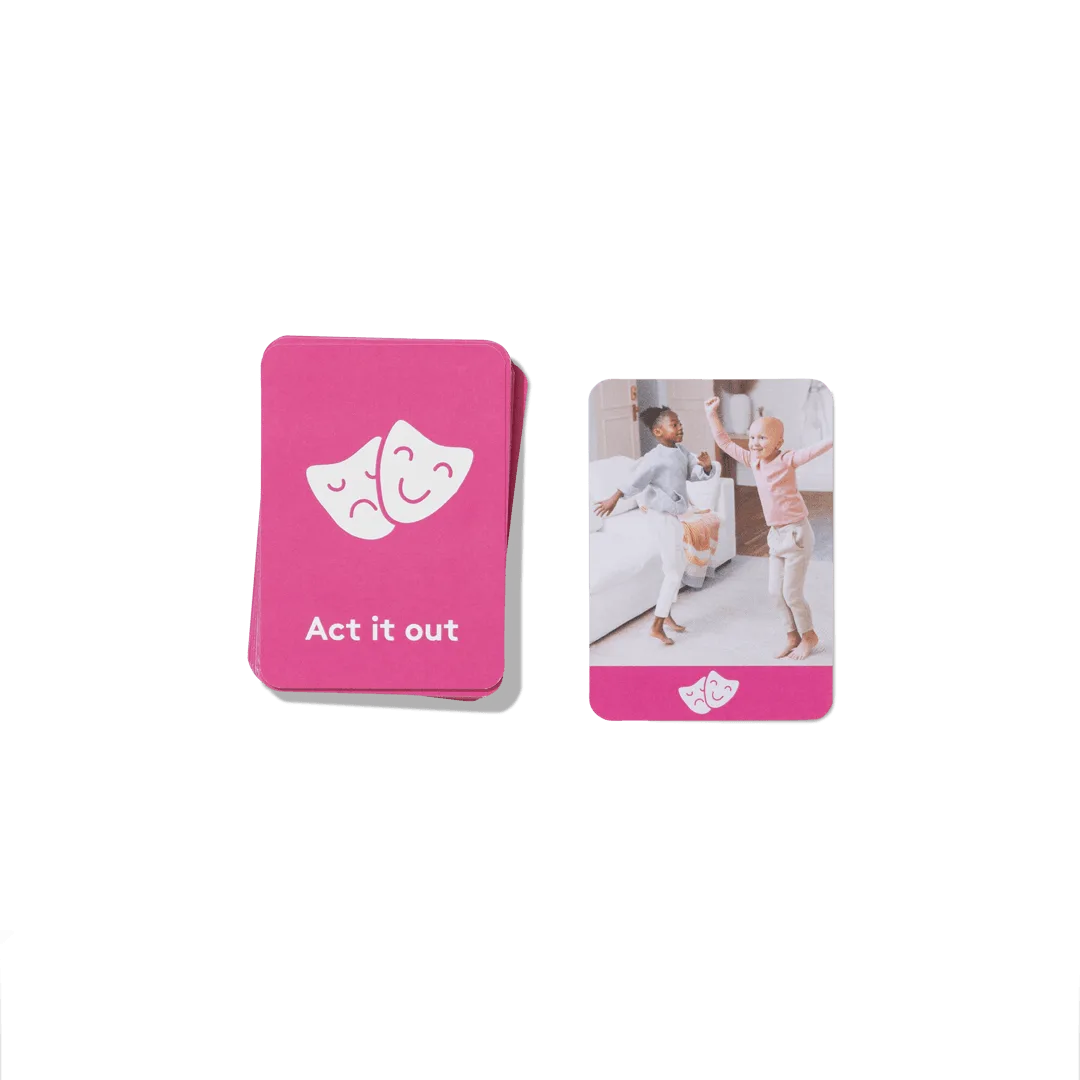
Empathy Game 'Act It Out' Cards (set of 20)