Quick answer
Most bedtime fussiness comes down to one of four things: a swaddle that is too loose, too tight, or past the point of usefulness; a wake window that is too long; a room that is too warm; or a routine that changes order from night to night. Fix the swaddle first, then the timing, then the environment. If your baby is still fighting sleep after three consistent nights, stop adjusting the swaddle and look at schedule or reflux instead.
Check the swaddle before you change the routine
A swaddle only helps if it stays put without pinning the arms flat. You should be able to slide two fingers between the fabric and your baby's chest. If you can fit more, the startle reflex will break the swaddle loose and wake your baby. If you cannot fit two fingers, the swaddle is restricting breathing and hip movement, and that alone can cause bedtime crying.
Hip health matters here. A safe swaddle leaves room for the legs to bend up and out at the hips. If the fabric pulls the legs straight down, loosen it or size up. Also check the arms: a swaddle that lets one hand escape gives your baby just enough freedom to scratch or startle, which often looks like fighting sleep when it is really a fit problem.
Time the last wake window before you add sleep props
A baby who is fussy at bedtime is often overtired, not under-tired. Stretching the last wake window to make bedtime later usually backfires: cortisol rises, and your baby fights sleep harder even though they are exhausted. Shorten the final wake window by 15 to 20 minutes for three nights and note whether the crying starts earlier or later.
Watch for the first tired cue, not the third. A single yawn, a stare, or a slow blink is the window. By the time your baby is rubbing eyes and arching, the window has closed and a swaddle alone will not settle them. If your baby is under 8 weeks, wake windows are short and change weekly, so recheck the timing every few days rather than setting one schedule and holding it.
Rule out heat and fabric before you blame the swaddle
Overheating looks like fighting sleep: your baby squirms, kicks off the swaddle, and cries harder when you add layers. A general guide is one more layer than you would wear to sleep in the same room. If the back of the neck is damp or hot, remove a layer before you change anything else.
Fabric choice matters for babies who run warm. A breathable organic cotton swaddle or sleep sack lets air move, while a thick synthetic blanket traps heat. If your baby sweats through a cotton swaddle, the room is likely too warm, not the fabric too thin. Lower the thermostat one degree and try again before buying anything new.
Keep the routine order fixed, not the clock
Babies read sequence, not time. A fixed order, such as feed, diaper, swaddle, dim light, song, bed, tells your baby what comes next. When you swap steps, the swaddle becomes a surprise instead of a signal, and bedtime fussiness goes up even if the total routine length is the same.
Keep the last step boring. If the final step is a bright light, a screen, or active play, your baby's nervous system gets a go signal right before sleep. Dim the room for the last two steps and keep your voice low. You do not need a long routine; four steps done in the same order every night work better than a ten-step routine that changes.
When to stop swaddling and change the plan
Stop swaddling at the first sign of rolling, even if it is only one direction and even if it happens during the day. A swaddled baby who rolls onto the stomach cannot push up, and that is a safety stop, not a sleep preference. Move to a sleep sack with arms free the same night.
If your baby is still fussy at bedtime after three nights of a correct swaddle fit, a shortened last wake window, a cooler room, and a fixed routine, the problem is probably not the swaddle. Look at reflux, teething, or a schedule that needs a bigger change, and talk to your pediatrician before adding new sleep products.
Bedtime fussiness diagnosis
- Symptom: baby cries the moment you lay them down: Likely cause: the swaddle loosened during the transfer, or your baby was already past the tired window before you started. Recheck the two-finger fit and move bedtime 15 minutes earlier for three nights before changing anything else.
- Symptom: baby squirms and kicks the swaddle off: Likely cause: overheating or a swaddle that is too tight at the hips, which makes your baby fight the fabric instead of settling. Remove one layer, lower the room temperature one degree, and confirm the legs can bend up and out. If it continues, stop swaddling and use a sleep sack.
- Symptom: baby is calm in arms but wakes 20 to 40 minutes after bedtime: Likely cause: a sleep-cycle transition with a startle reflex that a loose swaddle no longer contains. Tighten the swaddle to a two-finger fit and keep the routine order identical for three nights. If the waking continues past three nights, check the last wake window and feeding schedule.
Products that support a calmer bedtime
- Pearl Petal Sleeve Tee - Narelle Floral / Ivory + Sea: Made from 100% organic cotton interlock with a rib and elastane neckband, and colored with water-based dyes. A soft cotton layer under a swaddle or sleep sack adds warmth without trapping heat, and the neckband keeps its shape through repeated washing.
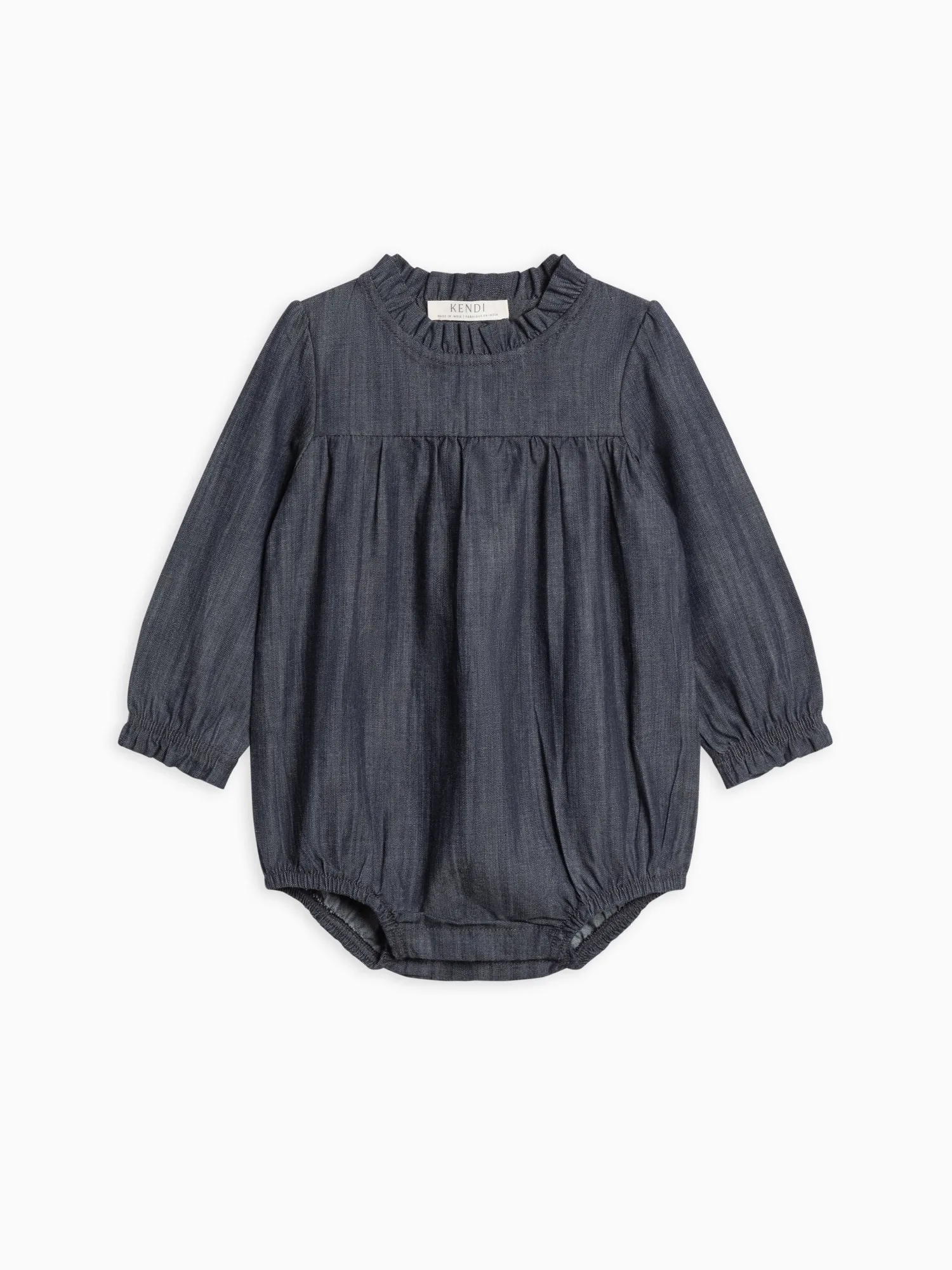
- Chantal Chambray Ruffle Romper: Features a ruffled neckline, elastic sleeve cuffs, elastic leg openings, back buttons, and nickel-free snap leg closures in 100% organic cotton chambray. Snap leg closures and back buttons make diaper changes faster at bedtime, so you can reset the routine without fully waking your baby.
- Ted Chambray Collared Romper: Made of 100% organic cotton, garment washed for softness, with a hidden snap leg opening, roomy pockets, and recycled plastic buttons. Garment washing softens the fabric before first wear, which matters for babies who are sensitive to stiff seams against the skin at bedtime.