Quick answer
If your laser lens loses focus, check contamination first: a smudged or dust-filmed surface scatters and absorbs light, shifting the effective focal point. If the optic is clean, the culprit is usually thermal lensing (heat-induced refractive index change) or a focal shift from a coating or substrate mismatch. Clean and re-seat the lens; if focus still drifts as power ramps up, the lens material or coating is wrong for your wavelength and power level.
Check contamination before you touch the mount
Dust, oil, and condensation on the lens surface are the most common reasons a laser lens loses focus. Contamination absorbs part of the beam, locally heating the optic and scattering light, which both reduces throughput and shifts the focal spot. Work in this order: inspect under oblique light, blow off loose particles with clean dry air or nitrogen, then use a lens tissue and reagent-grade solvent if a film remains. Never wipe a dry lens, since trapped grit will scratch the coating.
If the lens sits in a smoky, humid, or fume-heavy enclosure, contamination will return. Add a purge or a protective window upstream so the focusing optic stays clean longer. That single change often resolves recurring laser focusing lens problems without touching the optical design.
Separate thermal lensing from a true focal shift
Thermal lensing causes the focal length to change as the optic heats: the beam is absorbed, the substrate warms, its refractive index and shape shift slightly, and the focus walks away from your set point. The tell is behavior over time. If focus is correct when you start and drifts after seconds or minutes at full power, you are seeing thermal lensing, not a fixed alignment error.
A true focal shift laser lens issue behaves differently: focus is wrong immediately and stays wrong at every power level. That points to a wavelength or coating mismatch, a lens installed backwards, or a focal length that no longer matches your working distance. Test at low power first. If the spot is already off at low power, the problem is optical selection, not heat.
Match the substrate and coating to the job
Substrate choice sets how much the lens moves under heat and how it transmits your wavelength. N-BK7 optical glass is a practical, cost-effective choice for many visible and near-infrared focusing tasks, while S1-UV grade fused silica handles UV and higher-power beams with lower thermal distortion. Neither is universally better; the right pick depends on wavelength, power density, and how tightly you need to hold focus.
Coating matters just as much. A coating optimized for the wrong band reflects energy instead of transmitting it, which both weakens the beam and heats the optic, feeding thermal lensing. When you specify a replacement, order by design wavelength and confirm the coating band covers your source. If the catalog does not list a specification you need, treat that as a limitation to resolve with the supplier rather than assuming it is covered.
Stop here if the lens is damaged
Inspect for pitting, crazing, or coating discoloration. Any of these means the optic is degraded and cleaning will not restore focus. Replace it. Continuing to run a damaged lens risks scattering light into the mount and damaging downstream optics, which turns a low-cost part into a system repair.
If the lens is clean, undamaged, and correctly specified, and focus still drifts, the problem is outside the optic. Look at mount stability, thermal expansion of the holder, or beam-pointing instability from the source. At that point, stop swapping lenses and address the mechanical or source-side cause.
Focus-drift diagnosis table
- Focus drifts only after warm-up: Thermal lensing: absorbed beam energy heats the substrate and changes its effective focal length. Reduce power density, improve cooling, or switch to a lower-absorption substrate such as fused silica. If drift scales with power and time, treat it as thermal, not alignment.
- Focus is wrong at all power levels: Focal shift from a specification mismatch: wrong design wavelength, coating band outside your source, or a lens installed backwards. Verify part number, orientation, and coating against the source. If the spot is off at low power, replace or reorient the optic rather than compensating with the mount.
- Focus degrades gradually over days: Contamination buildup: dust or film absorbs and scatters light. Clean with proper technique and add a purge or protective window to slow recurrence. If cleaning restores focus but it returns, fix the environment, not just the lens.
- Focus is unstable even with a clean, correct lens: Mechanical or source-side cause: mount creep, thermal expansion in the holder, or beam-pointing drift. Check the mount and source before buying another optic. Stop replacing lenses once the optic is ruled out; the fault is elsewhere in the train.
Optics that reduce focus drift
- Bestform Laser Lenses, N-BK7 Optical Glass*: Bestform lenses use a shape factor chosen for the lens material to reduce spherical aberration when focusing a laser beam to a minimum spot. A tighter, more predictable spot makes any residual focus drift easier to detect and correct, since the baseline spot is smaller to begin with.
- Bestform Laser Lenses, S1-UV Grade Fused Silica: This Bestform lens is made from S1-UV grade fused silica and is specified by diameter, focal length, and design wavelength. Fused silica tolerates UV and higher power better than glass, so it holds focus longer in applications where thermal lensing is the main culprit.
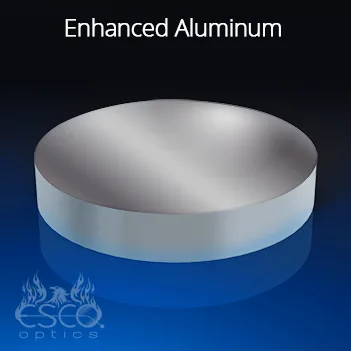
- Fused Silica Precision Quality Flat Mirrors, Enhanced Aluminum: These fused silica flat mirrors use enhanced aluminum coating with Ravg > 90% from 450 to 2000 nm and are polished to 1/10 wave surface accuracy. A high-reflectance, flat steering mirror keeps beam quality intact before the focusing lens, so you are not chasing focus errors caused upstream.