Quick answer
Choose a 10.6 µm Verifire Interferometer if you primarily test CO₂ laser optics at the standard 10.6 µm wavelength. Choose a dual-band 3.39 µm / 10.6 µm transmission flat if you need to qualify optics at both wavelengths but already own a compatible IR interferometer.
Wavelength matters for your optics
10.6 µm is the standard wavelength for CO₂ laser systems, making a dedicated 10.6 µm interferometer the natural choice for production or R&D testing of those optics. A 3.39 µm setup is often used for testing the same optics because many materials (like ZnSe) transmit at both wavelengths, but the shorter wavelength gives higher sensitivity to surface defects.
If your lab works exclusively with CO₂ lasers, the 10.6 µm Verifire Interferometer delivers a purpose-built solution. If you need to characterize optics at both wavelengths for design validation or acceptance testing, a dual-band transmission flat lets you switch between them without buying two complete interferometers.
Aperture size and test capacity
The 10.6 µm Verifire Interferometer comes with a 2-inch aperture and 1X fixed magnification. That is sufficient for small-diameter optics but limits your ability to test larger components in a single pass. The dual-band transmission flats are available in 2-inch and 6-inch sizes, giving you more flexibility to match your part size.
If you routinely test optics larger than 2 inches, the 6-inch IR TF (3.39 µm / 10.6 µm) allows you to cover a wider range of parts. The trade-off is that you need a compatible IR interferometer to use it — the Verifire is one option, but the transmission flat itself does not include the interferometer engine.
Surface quality specification
Both the 2-inch and 6-inch dual-band transmission flats are specified at 150 nm PVr surface quality. That is a practical specification for most infrared optics work, but it may not be tight enough for ultra-precision applications that demand sub-100 nm wavefront error. The Verifire Interferometer's encoded focus and fixed magnification help ensure repeatable measurements, but the final wavefront accuracy depends on the reference flat and test setup.
If your application requires better than 150 nm PVr, you should verify the reference flat's certification and consider whether a custom flat with a tighter spec is needed. The catalog flats offer a good balance of cost and performance for general IR metrology.
Trade-offs at a glance
- 10.6 µm Verifire Interferometer (2-inch aperture): Best for dedicated CO₂ laser optics testing. Includes the interferometer engine, encoded focus, and fixed 1X magnification. Limited to 2-inch clear aperture. Choose this if you need a complete, ready-to-run system and test parts ≤2 inches.
- 6-inch dual-band IR TF (3.39 µm / 10.6 µm): Transmission flat only — requires a compatible IR interferometer. Offers 6-inch aperture and dual-wavelength capability. Specified at 150 nm PVr. Choose this if you already own an IR interferometer and need to test larger optics or switch between wavelengths.
- 2-inch dual-band IR TF (3.39 µm / 10.6 µm): Smaller, lower-cost transmission flat for dual-band use. Same 150 nm PVr spec and ZnSe material as the 6-inch version. Uses a 4-inch bayonet mount. A budget-friendly option if your parts are small and you already have a compatible interferometer.
Product facts
-
10.6 µm Verifire Interferometer with 2 in. Aperture: The ZYGO 10.6 μm Verifire Interferometer has a 2-inch aperture, 1X fixed magnification, and encoded focus. It is a complete, dedicated system for testing CO₂ laser optics at 10.6 µm, but the small aperture limits the size of parts you can measure in one pass.
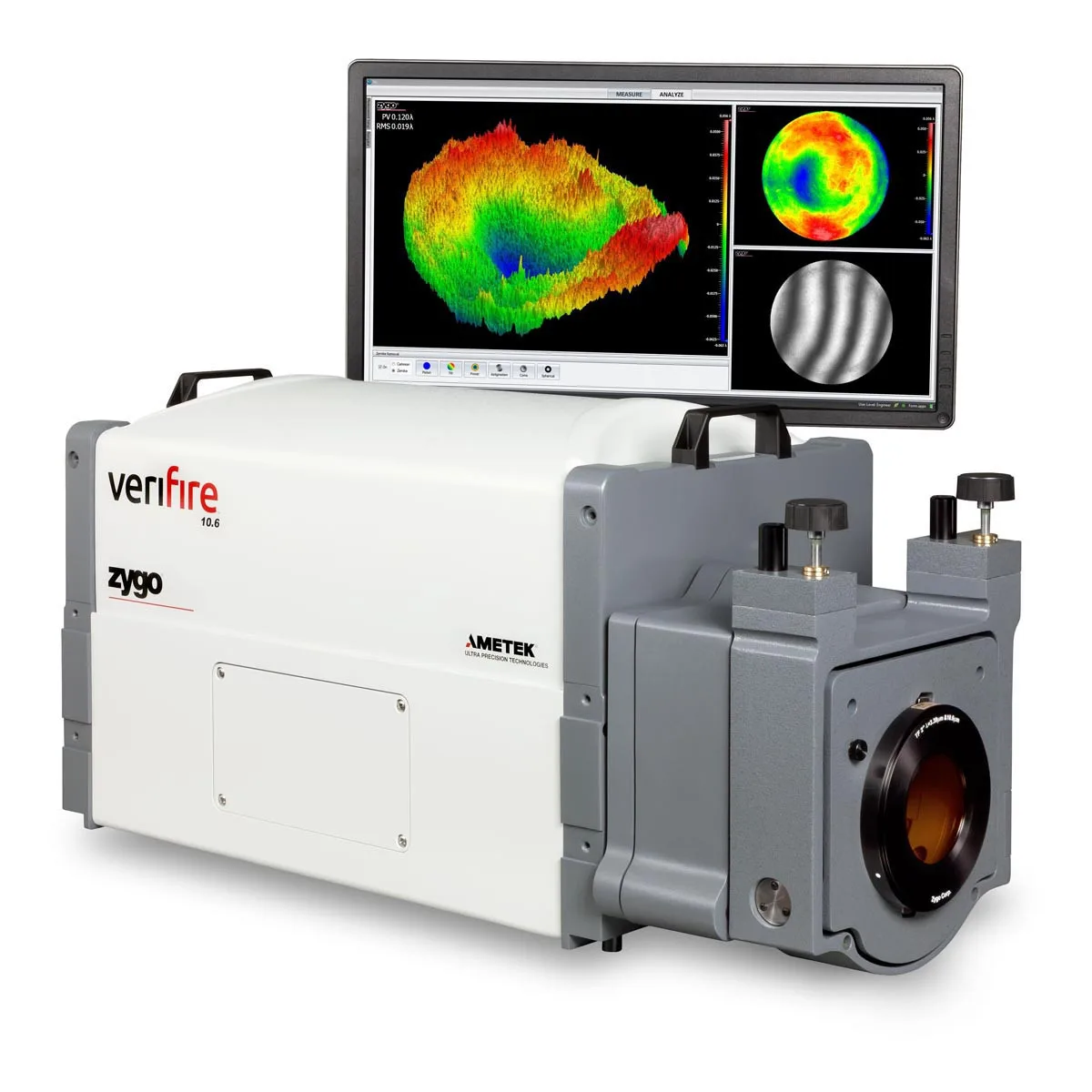
10.6 µm Verifire Interferometer with 2 in. Aperture
-
6" IR TF, 3.39um and 10.6um: The ZYGO 6-inch IR TF is a dual-band transmission flat for 3.39 µm and 10.6 µm, made of ZnSe with 150 nm PVr surface quality. It lets you test optics at both wavelengths with a single reference flat, and the larger 6-inch aperture accommodates bigger components than the Verifire's 2-inch aperture.
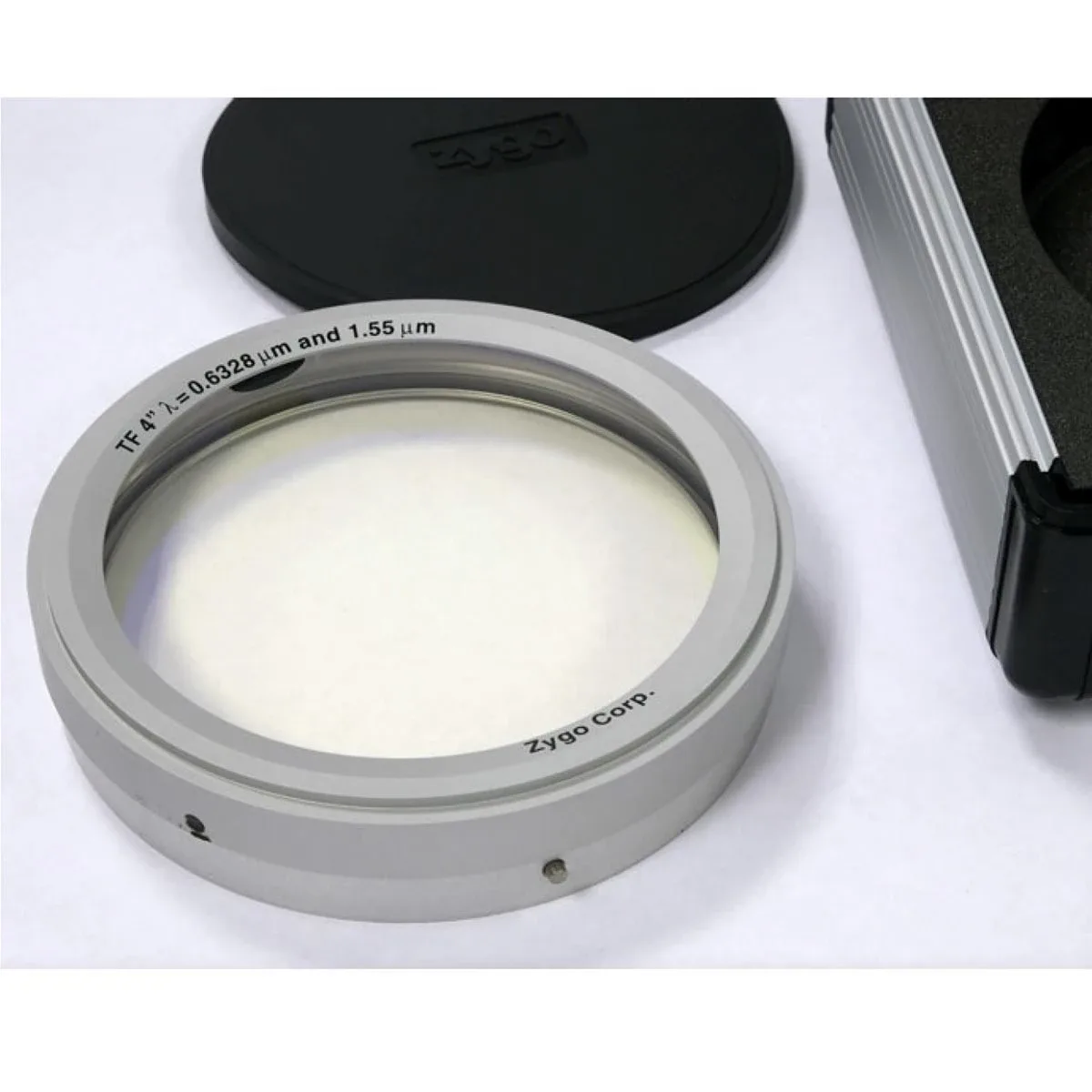
6" IR TF, 3.39um and 10.6um
Which setup fits your lab?
Best for
- Labs that test CO₂ laser optics exclusively and want a complete, dedicated interferometer with a 2-inch aperture.
- Facilities that already own an IR interferometer and need a dual-band transmission flat to qualify optics at both 3.39 µm and 10.6 µm.
Not for
- Users who need to test optics larger than 2 inches in a single pass with a complete interferometer — consider a larger-aperture system or a dual-band flat with an existing interferometer.
- Applications requiring sub-100 nm PVr surface quality — the catalog flats are specified at 150 nm PVr.