Quick answer
Start by sorting pieces by color and pattern, then assemble the border first. Focus on the dog's face and thought bubbles to build the rest efficiently.
Why this puzzle’s art makes assembly unique
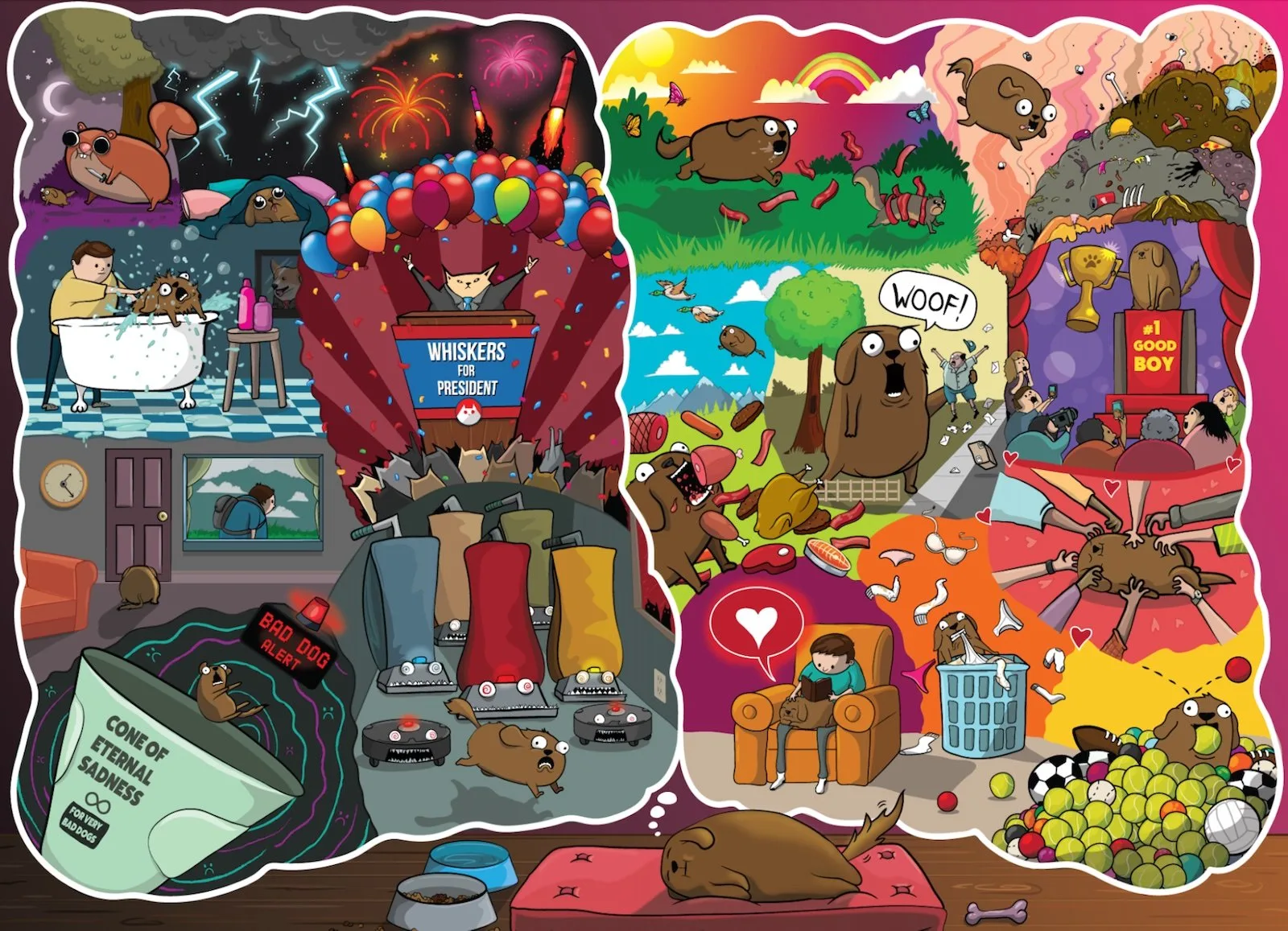
The Dreams and Nightmares of a Dog puzzle features detailed illustrations by Matthew Inman of The Oatmeal. The thought bubbles show Rambo’s dreams (squirrels wrapped in bacon) and nightmares (vacuum cleaners). This variety of small, distinct scenes helps you sort pieces by subject matter, but the similar color palette in some areas can be tricky.
Because the puzzle has many tiny stories, you can work on separate sections at the same time. The trade-off is that the dog’s fur and background use similar browns and creams, so you’ll need patience with those parts.
What to know before you start
This is a 1000-piece puzzle, so plan for a few sessions. The box dimensions are standard, but the piece shapes vary. You’ll need a flat surface and good lighting to see the fine details in the thought bubbles.
If you’re new to large puzzles, start with the border. The edge pieces are easier to identify and give you a frame. For this puzzle, the border has a consistent cream color, so look for straight edges first.
Step-by-step assembly guide
- Sort by color and pattern: Separate pieces into piles: border edges, Rambo’s face and body, dream thought bubbles (bright colors like red and yellow), nightmare thought bubbles (darker tones like gray and blue), and background. Use the box image as a reference. Common mistake: mixing similar browns from the dog’s fur with background pieces. Keep them in separate piles.
- Assemble the border first: Find all straight-edged pieces and connect them to form the frame. The border is mostly cream-colored, so check each piece for a flat edge. This gives you a defined workspace. Checkpoint: ensure the border is square and corners match the box image before moving on.
- Build the dog’s face and body: Focus on Rambo’s face first—it has distinctive features like eyes, nose, and mouth. Then connect the body using the brown and cream pieces. The fur has subtle shading, so use the box art to match patterns. Common mistake: forcing pieces that look similar but don’t fit. If a piece doesn’t click, set it aside and try another.
- Tackle the thought bubbles: Work on each thought bubble separately. The dreams (right side) have bright colors and clear subjects like squirrels and tennis balls. The nightmares (left side) use darker tones. Assemble each bubble as a mini-puzzle, then attach them to the dog’s head. Checkpoint: verify that the thought bubble pieces align with the dog’s head orientation—upside-down pieces are common here.
- Fill in the background: After the main image is complete, add the remaining background pieces. These are mostly cream and light brown. Use the border as a guide and work inward. If you get stuck, rotate pieces to see if they fit from a different angle. Common mistake: assuming background pieces are interchangeable. Each piece has a unique shape, so test each one carefully.
Product details
-
The Dreams and Nightmares of a Dog (1000 Piece Puzzle): This puzzle was drawn by Matthew Inman of The Oatmeal. It’s based on his dog, Rambo. The thought bubbles over Rambo’s head show what he dreams about while he’s napping. The distinct thought bubbles act as mini-puzzles within the larger image, making it easier to tackle in sections.
The Dreams and Nightmares of a Dog (1000 Piece Puzzle)