Quick answer
A fused silica precision flat mirror is used to redirect or reflect light with minimal distortion, especially in laser systems, UV spectroscopy, and interferometry where thermal stability and surface accuracy are critical.
Why choose fused silica over other substrates?
Fused silica offers extremely low thermal expansion and high resistance to thermal shock, making it ideal for applications with temperature fluctuations or high-power lasers. It also transmits well into the UV range, which is why it's preferred for UV spectroscopy and excimer laser systems. The trade-off is cost: fused silica mirrors are more expensive than standard glass or N-BK7 alternatives.
When do you need a precision flat mirror?
A precision flat mirror with 1/10 wave surface accuracy is necessary when wavefront distortion must be minimized, such as in interferometry, beam expansion, or laser cavity alignment. For less demanding applications like simple beam steering or projection, a commercial grade mirror may suffice at lower cost.
Frequently asked questions
What is the main use of a fused silica precision flat mirror?
It is primarily used to redirect laser beams or other light paths with minimal wavefront distortion. Common applications include laser cavities, beam steering, interferometry, and UV spectroscopy.
Can I use an uncoated fused silica flat mirror for UV light?
Yes, uncoated fused silica has good transmission in the UV, but reflection is low (about 4% per surface). For high reflectivity in the UV, a UV Enhanced Aluminum coating (e.g., Ravg. > 90% from 250-450nm) is recommended. Choose an uncoated mirror only if you need partial reflection or transmission; otherwise, specify a UV-enhanced coating.
What surface accuracy do I need for laser applications?
For most laser beam steering and cavity mirrors, 1/10 wave surface accuracy (as offered on the Esco Optics fused silica mirrors) is sufficient. For very high-power or single-mode lasers, you may need 1/20 wave or better. Check your laser's wavefront tolerance before selecting a mirror grade.
How does the diameter tolerance affect mounting?
The diameter tolerance of +0/-0.1mm ensures a snug fit in standard mirror mounts without excessive play. This is important for maintaining alignment in optical systems. Verify your mount's bore diameter to ensure compatibility.
Relevant product
-
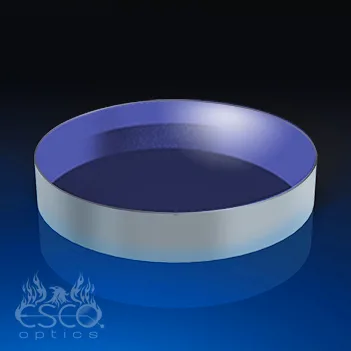
Fused Silica Precision Quality Flat Mirrors, Uncoated: Esco Optics offers precision quality flat mirrors coated with UV Enhanced Aluminum providing Ravg. > 90%, 250-450nm. Manufactured using Fused Silica (25.4mm, 50.8mm), these mirrors are polished to 1/10 wave surface accuracy and 40/20 scratch/dig over an 85% aperture. This combination of UV-enhanced coating and high surface accuracy makes the mirror suitable for UV laser beam steering and spectroscopy where both reflectivity and wavefront preservation are critical.
Fused Silica Precision Quality Flat Mirrors, Uncoated