Quick answer
Play on it. A new backgammon board breaks in best through gentle, regular use: roll on the surface, move checkers across every point, and let the hinge and cups loosen naturally. Clean with a dry or barely damp cloth, keep drinks off the felt or leather, and store the set closed with its checkers and cups inside so nothing presses into the playing surface.
What actually changes during the first few weeks
A new board is not stiff in the way a new pair of boots is stiff. The parts that change with use are the hinge, the playing surface, and the dice cups. Hinges on folding boards loosen slightly as they cycle open and closed. Felt or leather playing surfaces compress a little where checkers land most often, which is normal and usually reads as a softer, quieter roll rather than wear. Dice cups soften at the rim and interior, so the shake becomes less rattly and more controlled.
The goal of breaking in is to let those changes happen evenly. If you only ever play on one side or one quadrant, the board ages unevenly. Rotate which side you open, and vary where you start your checkers so no single point takes all the traffic.
Set up a clean, stable playing spot first
Most early damage to a new board comes from the table underneath it, not the game itself. Play on a flat, non-abrasive surface. Avoid glass, rough stone, or a table with grit on it, because the board's underside and edges will pick up scratches every time you slide it. If you use a tablecloth, make sure it is smooth and free of crumbs.
Keep drinks and snacks on a separate side table. A single ring on a felt or leather surface is permanent, and it cannot be buffed out the way a wooden edge can. This one habit prevents the most common backgammon board cleaning problem before it starts.
Break in the hinge and the fold
Open and close the board slowly for the first several sessions. Let the hinge travel through its full range instead of snapping it open. If your board has a spine or a clasp, close the clasp gently rather than pressing it shut. This is also the time to notice whether the two halves sit flush when open. If they do not, check that the hinge is not being forced by a warped table or by checkers left inside the fold.
A hinge that feels tight at first is normal. A hinge that grinds, clicks, or feels loose out of the box is not something to break in; stop and contact the seller.
Condition the playing surface and points through play
The fastest, safest way to break in the points and playing field is to actually play. Roll the dice on the surface, move checkers across the board, and hit and re-enter pieces as you normally would. This distributes pressure and lets the surface settle evenly. If you are breaking in a board before a tournament or a gift, play a few casual games rather than pressing or rubbing the surface by hand.
Do not use oils, waxes, or conditioners on a felt or leather playing surface unless the manufacturer explicitly says to. Most backgammon points maintenance is simply keeping the surface clean and dry. If your board has a wooden exterior, a dry microfiber cloth is enough for routine dust; leave polishes for furniture, not game boards.
Care for the dice cups and dice
Dice cups take more handling than any other part of the set, so backgammon dice cups care is mostly about keeping them dry and unstressed. Shake with a normal wrist motion rather than slamming the cup on the table. Slamming cracks rims and dents leather or wood over time. Empty the cups after each session so dice do not sit against the interior and leave pressure marks.
Wipe the cups with a dry cloth. If the interior is leather, do not wet it. If the cups are wood, keep them away from radiators and direct sun, which can dry and split them. Store dice in a small bag or the set's dice tray rather than loose in the case, where they can scratch the board.
Clean without overdoing it
For routine backgammon board cleaning, start dry. A microfiber cloth removes dust, chalk, and skin oil from most surfaces. For a sticky spot on a hard playing surface, use a cloth barely dampened with water and dry immediately. Never soak the surface, and never pour cleaner directly onto the board.
For a leather backgammon case or a leather playing field, skip alcohol, solvents, and household sprays. These strip finishes and can darken or crack leather. If the leather is genuinely soiled, use a product made for leather and test it on a hidden area first. When in doubt, do less.
Store the set so it holds its shape
Storing a backgammon set correctly is the difference between a board that still lies flat in five years and one that develops a bow. Close the board with all checkers, dice, and cups in their proper compartments so nothing presses into the playing surface. If your set has a case or a bag, use it. If it does not, store the board flat, not leaning against a wall, and not stacked under heavy objects.
Keep the set out of attics, garages, and direct sunlight. Heat and humidity swings are harder on wood, leather, and felt than normal indoor conditions. A closet shelf at room temperature is ideal.
Your first-month break-in routine
- Play three or four full games on a clean, flat table: Set up on a smooth surface with no grit, and keep drinks on a side table. Play normally so checkers travel across every point. Checkpoint: after each session, run a dry cloth over the surface and close the board gently.
- Cycle the hinge slowly every time you open and close: Guide the board open rather than letting it snap, and press the clasp shut with light pressure. Do this for the first two weeks. Mistake to avoid: forcing a stiff hinge. If it grinds or feels loose, stop and contact the seller.
- Rotate which side you open and where you start: Alternate the half you open first and vary your starting points so wear and compression spread evenly across the board. Checkpoint: by the end of the first month, both halves should feel equally settled.
- Empty and wipe the dice cups after every session: Remove dice, shake out crumbs, and wipe cups with a dry cloth. Never wet a leather cup interior. Mistake to avoid: slamming cups on the table, which cracks rims and dents leather.
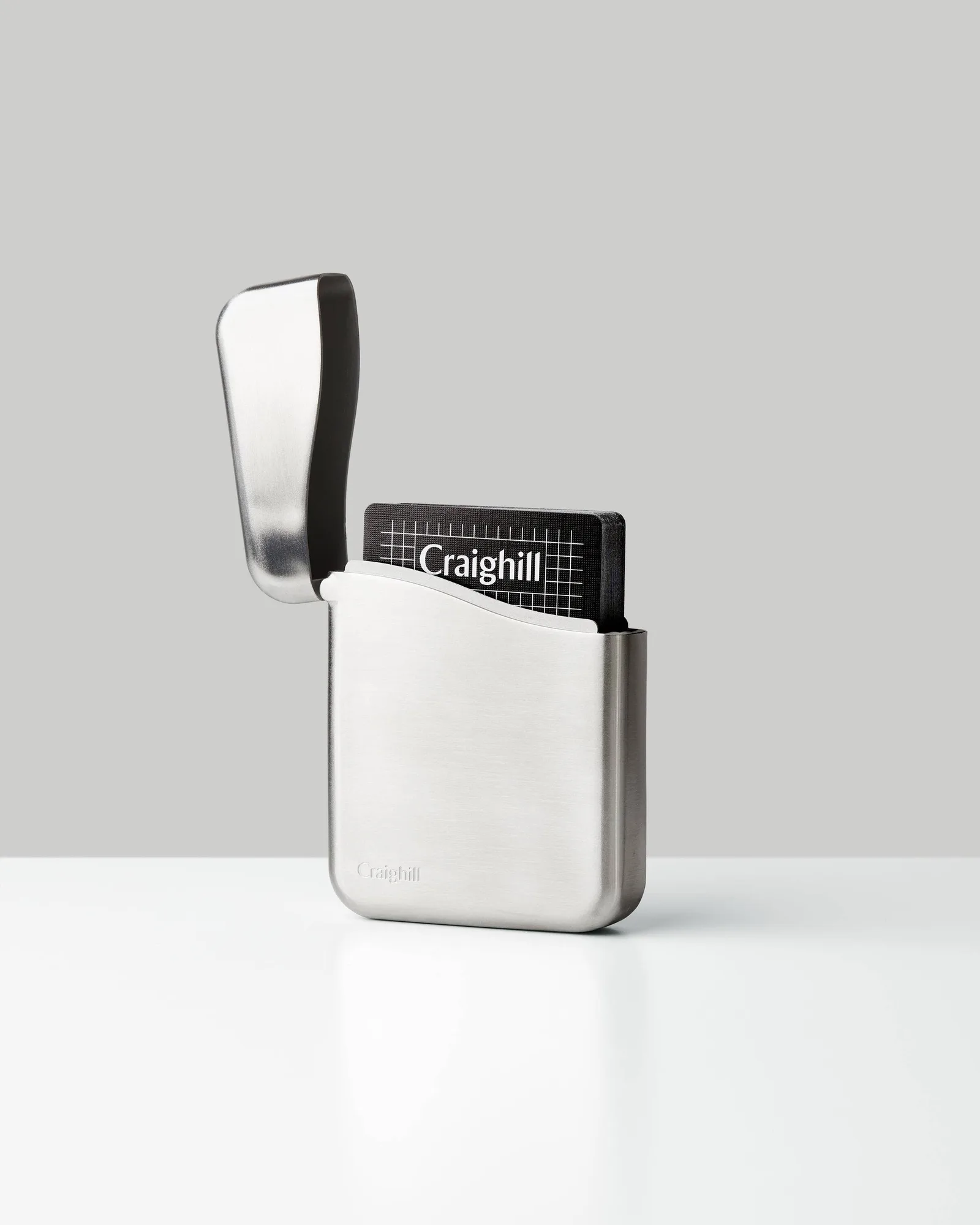
- Store flat with everything in its compartment: Close the board with checkers, dice, and cups secured so nothing presses into the playing surface. Keep it at room temperature, out of sun and damp. Next step: if you need a rigid home for loose cards and dice, consider a compact case rather than stacking them on the board.
A storage option worth knowing about
- Summit Playing Card Case: The Summit Playing Card Case from Craighill is designed to fit a standard deck of playing cards, with or without its box, and is made from a stainless steel metal injection molded body with a haptically-rewarding hinge mechanism. If you already keep cards, dice, or small game accessories loose in a drawer, a rigid case with a controlled hinge protects them from crushing and keeps them together. It is not sized for a backgammon board, so treat it as a companion for the small parts of your game collection rather than a board case.