Quick answer
For most low-light 35mm shooting, start with an ISO 800 film like CineStill 800T – it handles tungsten light well and gives a distinctive halation effect. But the best choice depends on your light source, desired look, and whether you need fine grain or a warmer palette.
Why ISO 800 is the sweet spot for handheld night photography
ISO 800 is fast enough to allow handheld shots in dim streetlight, bars, or interiors without a tripod, yet not so grainy that detail disappears. Lower ISO films (like 100 or 200) need long exposures or flash, while ISO 1600 or 3200 films can look noticeably more textured. For most photographers, 800 balances speed and quality.
Tungsten balance vs. daylight balance: a key difference
CineStill 800T is tungsten-balanced (3200K), meaning it renders warm incandescent or sodium vapor light as neutral white. Daylight-balanced films (like Portra 800 or Ultramax 400) will appear orange under the same light. If you shoot city streets at night, tungsten balance can save you from heavy color correction. But if you prefer a warm, nostalgic look, daylight film might be more pleasing straight out of the lab.
Remjet backing and lab processing
CineStill 800T is a motion picture stock that has had its remjet (anti-halation) backing removed. This makes it safe for standard C-41 processing at any lab, but it also creates a slight halation effect – a soft glow around bright highlights. Some photographers love this look; others prefer the cleaner results from films that retain remjet (like Kodak Vision3 stocks, which require specialty processing). For convenience and consistent results, CineStill 800T is an easy choice.
Grain and sharpness trade-offs
Higher ISO films generally show more grain. CineStill 800T has a visible, somewhat cinematic grain structure that many find pleasing. If you need the finest possible grain at ISO 800, look at modern emulsions like Kodak Portra 800, which is engineered for lower grain. But Portra 800 is daylight-balanced and costs more per roll. The trade-off is between a specific look (halation, tungsten balance) and technical fidelity.
Decision rules for choosing your ISO 800 film
- Light source: If your scene is lit by tungsten bulbs, candlelight, or streetlights, choose a tungsten-balanced film like CineStill 800T to avoid a strong orange cast. If you're mixing daylight and artificial light, a daylight-balanced film may be more versatile.
- Desired look: If you want a cinematic, slightly dreamy glow around highlights, go with CineStill 800T. If you prefer clean, sharp highlights with minimal halation, choose a film with remjet backing (like Kodak Vision3 stocks) or a still-camera emulsion like Portra 800.
- Convenience: CineStill 800T can be processed at any standard C-41 lab, just like any color negative film. If you don't have access to a specialty lab, this is the simplest path to a tungsten-balanced look. Always check with your lab before shooting a film with remjet backing – not all labs accept it.
- Budget: CineStill 800T is priced competitively (often around $13 per roll compared to $19 list), making it an affordable entry into high-speed film. If you shoot a lot, buying in multi-roll packs can bring the cost down further.
Product facts
-
CineStill Film 800 Tungsten Color Negative Film - 35mm Roll Film, 36 Exposures (ISO 800): CineStill 800T is a reformatted motion picture color negative film packaged for still cameras, with an ISO 800 tungsten balance and no remjet backing. It gives a unique halation effect and can be developed at any C-41 lab, making it a convenient and characterful choice for low-light street and interior photography.
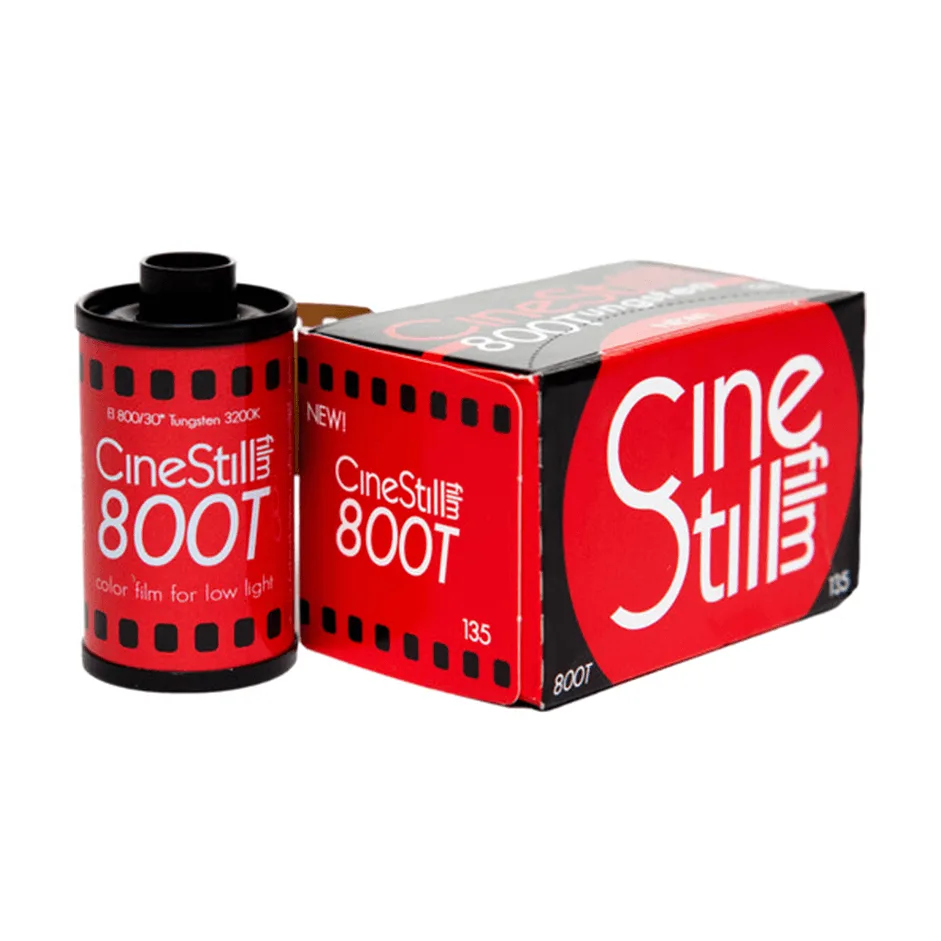
CineStill Film 800 Tungsten Color Negative Film - 35mm Roll Film, 36 Exposures (ISO 800)
Who should choose ISO 800 film?
Best for
- Night street photographers who want to shoot handheld under mixed artificial light
- Photographers who enjoy a cinematic, slightly glowing look and don't mind visible grain
- Anyone who needs a single film for both indoor and outdoor low-light situations
Not for
- Photographers who need the finest possible grain for large prints – consider ISO 400 or lower with a tripod
- Those who dislike halation or want a perfectly clean highlight rendering – look for films with remjet backing