Quick answer
Desoldering wick is a braided copper wire that absorbs molten solder when heated. To use it, place the wick on the solder joint, press a hot soldering iron tip onto the wick, and lift both away once the solder is absorbed.
Why desoldering wick works so well
Desoldering wick uses capillary action to pull molten solder into the braid. The copper wire is often pre-fluxed, which helps the solder flow into the wick instead of beading up on the board. This makes it one of the simplest methods for removing solder from through-hole components or surface-mount pads.
It is especially useful when you need to clear a solder bridge, replace a component, or fix a cold joint. Unlike solder suckers, wick leaves no plastic tip to melt and can reach tight spaces. The trade-off is that it can heat nearby components if you linger too long, and the used wick must be cut off after each application.
When to choose desoldering wick over other tools
Desoldering wick is ideal for small joints, delicate pads, and situations where you want minimal mechanical shock. A solder sucker (vacuum desoldering pump) works faster on large joints but can create splatter or damage fragile traces if not used carefully. For most hobbyist repairs, a roll of wick is cheaper and easier to control.
Step-by-step desoldering with wick
- Step 1 – Prepare your work area: Set your soldering iron to 300-350°C (570-660°F). Place the board in a holder or clamp. Cut a 2-3 cm piece of fresh desoldering wick. If the wick is not pre-fluxed, dip the end in a small amount of liquid or paste flux. A clean, tinned iron tip transfers heat faster. Replace the tip if it is oxidized.
- Step 2 – Position the wick: Lay the wick flat over the solder joint you want to remove. Press the soldering iron tip firmly onto the wick, directly above the joint. Hold for 1-3 seconds. You will see the solder melt and flow into the braid. Do not slide the iron sideways – this can lift pads. Lift the iron straight up once the solder is absorbed.
- Step 3 – Remove the wick and check the joint: Lift the iron and wick together while the wick is still hot. If any solder remains, cut off the used portion and repeat with a fresh piece of wick. For through-hole components, you may need to apply wick from the opposite side of the board. Never reuse a section of wick that has already absorbed solder – it will not absorb more and may stick to the board.
Product used in this guide
-
1.5 Meters of desoldering wick 1.5mm wide: 1.5 Meters of desoldering wick 1.5mm wide. Place the wick over the solder to be removed, then push a heated soldering iron tip onto the wick. The solder will simply be absorbed into the wick. The 1.5mm width is a good all-round size for most through-hole and small surface-mount pads, and the 1.5-meter length gives you many uses before needing a refill.
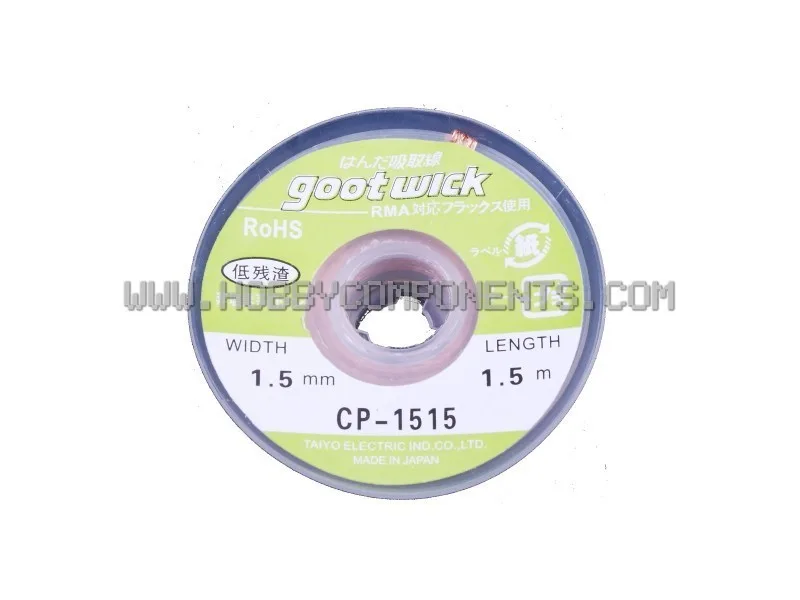
1.5 Meters of desoldering wick 1.5mm wide