Quick answer
Use a wall anchor rated for at least twice the mirror's weight, and always mount into a stud when possible. For natural rattan mirrors with open weave, attach the hanging hardware directly to the frame—not the woven surface—to avoid cracking or slipping.
Why natural rattan mirrors need special care
Rattan is a natural material that expands and contracts with humidity. That means a mirror that feels secure in dry weather may loosen when the air gets damp. The open weave also means you cannot simply screw into the back panel like a solid frame. The Guava Stripe Rattan Mirror, for example, uses hand-woven natural rattan that adds warmth but also requires you to attach hardware to the sturdy inner rim or a hidden wooden batten, not the woven surface itself.
Another consideration: rattan mirrors are often lighter than solid wood or metal frames, but their irregular shape can make it tricky to find the center of gravity. Always test the balance before drilling final holes.
Step-by-step guide to hanging your rattan mirror
- 1. Weigh the mirror and choose hardware: Place the mirror on a scale and note the weight. Buy a wall anchor and screw set rated for at least double that weight. For a mirror over 10 lb, use a toggle bolt or a stud-mounted screw. Common mistake: using a small nail or adhesive strip, which will not support the weight and can cause the mirror to fall. Always use hardware rated for at least twice the mirror's actual weight.
- 2. Find the hanging point on the mirror: Lay the mirror face down on a soft towel. Look for a pre-installed D-ring, wire, or keyhole bracket on the back. If none exists, attach a D-ring to the solid wooden or MDF frame—never screw into the rattan weave itself. Common mistake: assuming the center of the mirror is the balance point; test by lifting the mirror by the hardware to see if it hangs level. If the mirror tilts forward, the hanging point is too low; adjust upward.
- 3. Mark the wall position: Hold the mirror against the wall at the desired height. Use a pencil to mark the top center and the location of the hanging hardware. Use a level to ensure the marks are straight. Common mistake: marking only one point; two marks (one for each hanger) prevent the mirror from shifting later. For wide mirrors, use two wall anchors spaced evenly to prevent rocking.
- 4. Drill pilot holes and install anchors: Drill a pilot hole at each mark. If you hit a stud, drive a screw directly into the stud. If not, insert a wall anchor (toggle bolt or plastic expansion anchor) that matches your drywall thickness. Common mistake: using a drywall anchor rated for a lower weight than the mirror, which can pull out over time. Test the anchor by pulling it gently before hanging the mirror.
- 5. Hang the mirror and check stability: Lift the mirror onto the installed screws or hooks. Gently push on each corner to confirm it does not wobble. If it moves, tighten the screws slightly or add a felt bumper behind the bottom edge to keep it flush. Common mistake: ignoring a wobble, which can lead to the mirror shifting and falling. Check stability monthly, especially after humidity changes, and retighten if needed.
Product facts
-
Guava Stripe Rattan Mirror: Hand woven natural rattan that adds warmth and artisanal texture Because the weave is decorative, not structural, you must attach hanging hardware to the solid frame or a hidden batten rather than directly into the rattan strands.
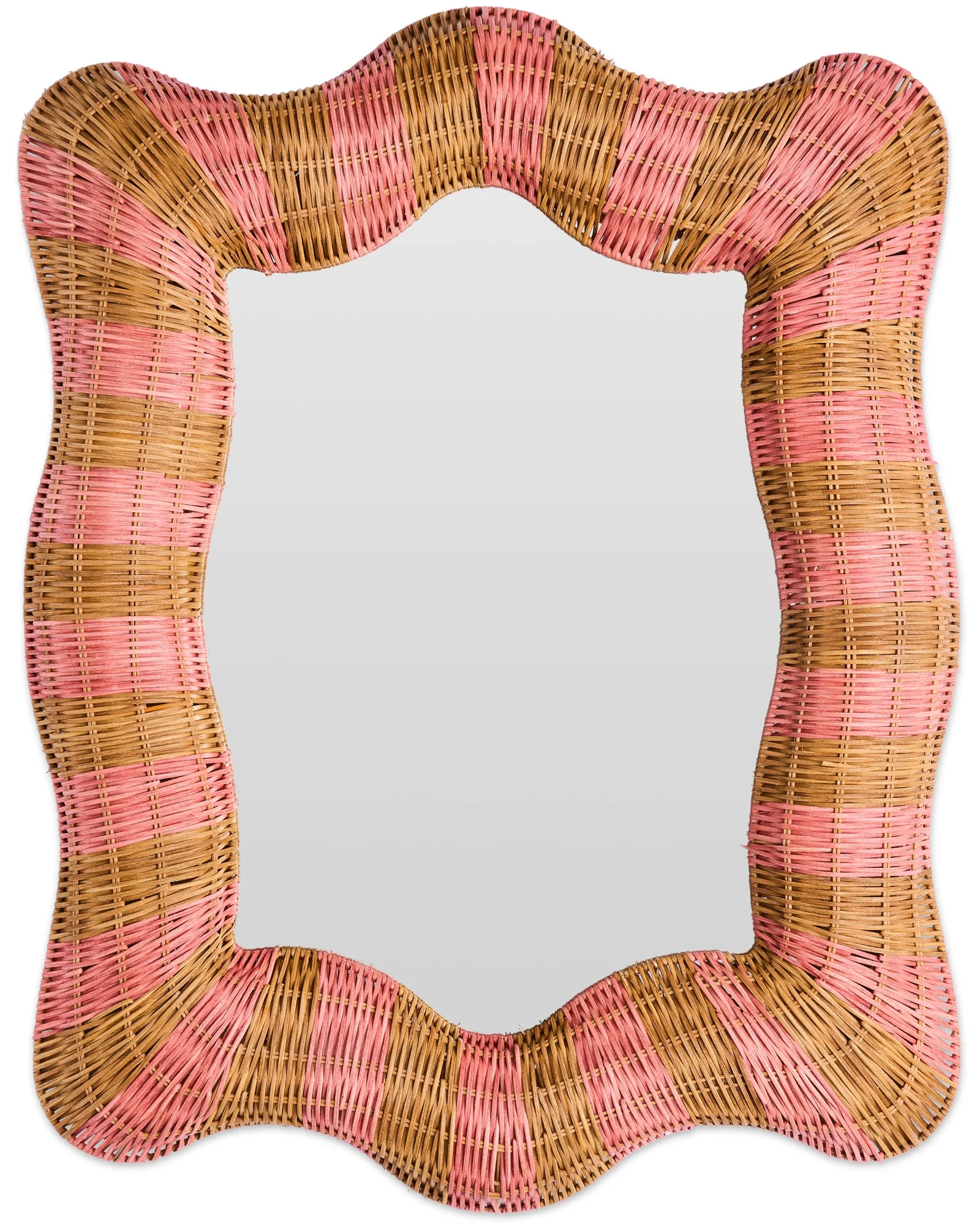
Guava Stripe Rattan Mirror