Quick Answer
To set up Agricola Revised Edition, first unfold the game board, separate the components by type, then deal Occupation and Minor Improvement cards to each player. Follow the step-by-step process below for your first game.
Why Setup Order Matters in Agricola
Agricola Revised Edition is a deep strategy game where every decision counts. Setting up correctly ensures you don't miss key components like the family growth spaces or the round marker. A common mistake is placing the wrong number of resources on action spaces, which can unbalance the early game.
The game simulates 17th-century farming life, and the setup reflects the gradual expansion of your farm. Take your time with the first setup—it's part of learning the rhythm of the game.
Agricola Revised Edition Setup Steps
- Unfold the Game Board and Place the Round Marker: Unfold the large game board and place it in the center of the table. Find the round marker (a small wooden disc) and place it on the first space of the round track (the top-left space). Common mistake: placing the marker on the harvest track instead of the round track. The round track shows which action spaces are active each round.
- Separate and Sort All Component Types: Open all bags and punch out cardboard tokens. Sort into piles: food (grain, vegetables, sheep, wild boar, cattle), resources (wood, clay, reed, stone), and special tokens (fences, stables, fields, rooms). Place each pile near the board for easy access. Checkpoint: ensure you have the correct number of each resource token for the player count. The rulebook lists exact quantities.
- Deal Occupation and Minor Improvement Cards: Shuffle the Occupation deck and the Minor Improvement deck separately. Deal 7 Occupation cards and 7 Minor Improvement cards to each player. Players look at their own cards but keep them hidden from others. First-play tip: if you're overwhelmed, play with the simplified 'Family Game' variant that uses fewer cards.
- Place Starting Resources on Action Spaces: Refer to the rulebook's setup table for your player count. Place the indicated number of wood, clay, reed, stone, and food tokens on the corresponding action spaces. For example, the '3 Wood' space gets 3 wood tokens. Common mistake: forgetting to place resources on spaces that are not used until later rounds. Only place resources for round 1 initially.
- Give Each Player a Starting Farm Board and Pieces: Each player takes a farm board (showing a 3x3 grid of fields). Place your starting house (a wooden room piece) on the center-left space. Place your spouse (a neutral-colored meeple) on the 'Starting Player' space on the board. Checkpoint: the starting player marker is separate from the round marker. The starting player changes each round.
- Set Up the Food and Family Growth Tracks: Place the food supply (grain, vegetables, and food tokens) within easy reach. Locate the family growth action space on the board and place the 'Family Growth' marker there. Set aside the 'Begging Cards' (used if you can't feed your family). First-play tip: you start with 2 food tokens. Do not spend them until the first harvest phase.
Product in this Guide
-
Agricola revised Edition: In Agricola (Latin for farmer), you're a farmer in a wooden shack with your spouse and little else. You might think about having kids in order to get more work accomplished, but first you need to expand your house. This explains why house expansion and food production are central mechanics—you'll need to plan your early moves around building rooms and securing food.
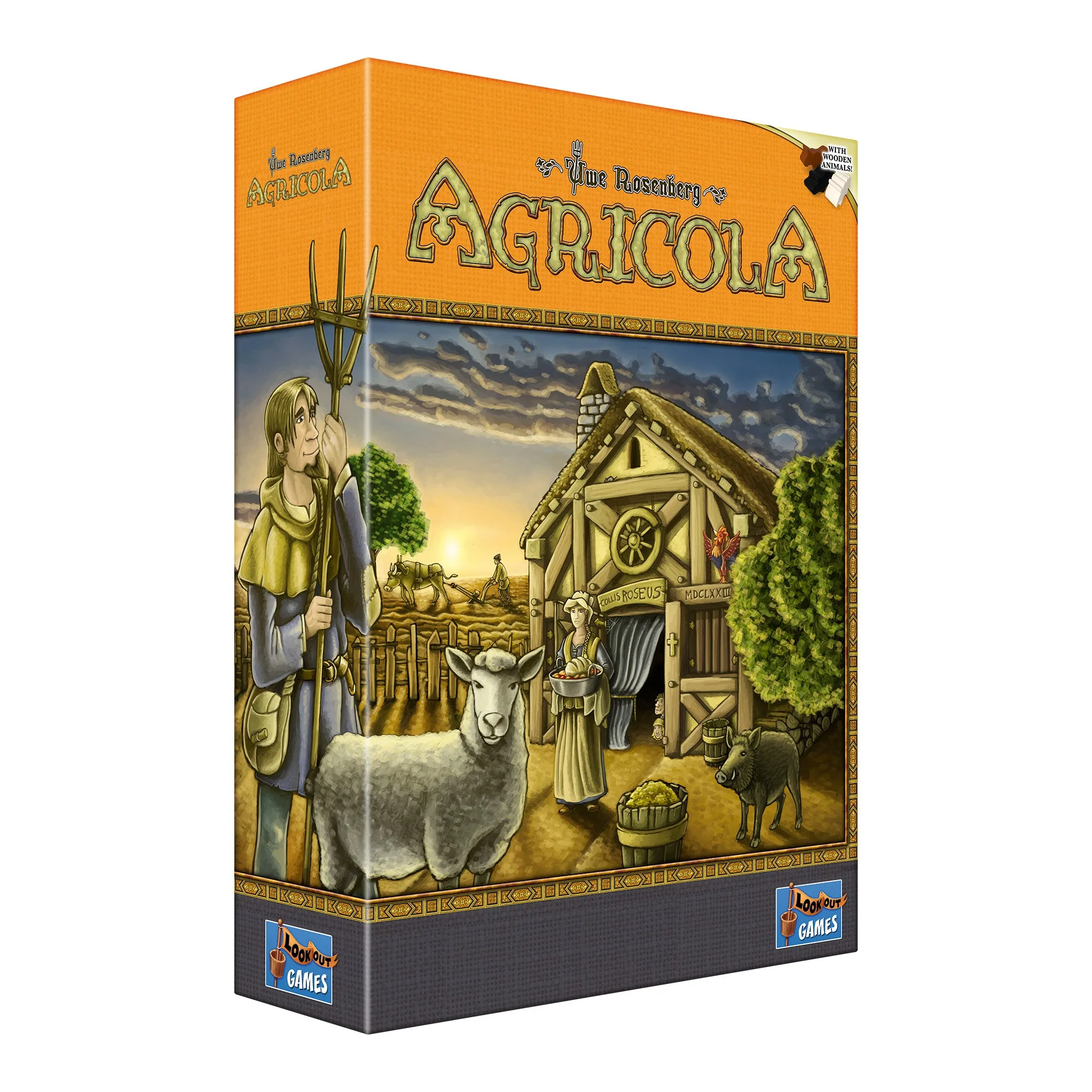
Agricola revised Edition