Quick answer
Start with color sorting, then move to counting and patterning using the Rainbow Stacking Bears set. Use the cups, tongs, and dice to turn each activity into a hands-on lesson.
Why Sorting and Counting Matter
Sorting and counting are foundational early math skills. They help children recognize patterns, compare quantities, and understand one-to-one correspondence—skills that build a bridge to addition and subtraction. The Rainbow Stacking Bears set is designed for these exact activities, with 60 bear counters in multiple colors and matching cups.
Because the bears come in different colors and sizes, you can adjust the difficulty as your child grows. Start with simple color matching, then move to counting and patterning. This keeps the activity challenging without being frustrating.
Why Sorting and Counting Matter Before School
Sorting and counting are foundational early STEM skills. When children sort bears by color or count them one by one, they practice one-to-one correspondence, grouping, and comparison—skills that build a strong math foundation. The Rainbow Stacking Bears set includes 60 bear counters in rainbow colors, matching cups, and a sorting dice game, making it easy to introduce these concepts in a playful way.
What to Keep in Mind
Start with simple activities and gradually add complexity. Young toddlers may need help holding the tongs or placing bears, while preschoolers can handle more advanced sorting rules. Adjust the difficulty based on your child's focus and fine motor skills.
Step-by-Step Sorting and Counting Activities
- Start with color sorting: Place the rainbow cups in a row and have your child drop each bear into the matching cup. Start with two colors and add more as they gain confidence. Common mistake: rushing to all six colors at once can overwhelm a toddler, so begin with two or three colors and gradually increase. Check that your child can consistently sort two colors before introducing a third.
- Practice one-to-one correspondence: Line up one bear under each cup or place bears in a row. Have your child touch one bear while saying one number. This builds the foundation for counting and number sense. Pause after each bear to confirm the count matches the object.
- Introduce simple addition and subtraction: Start with small groups, like 2 bears plus 3 bears. Use the cups as visual containers to show how groups combine or separate. Ask your child to count the total or find how many are left. Use the sorting cups to physically separate groups so the math stays visible.
- Play the sorting dice game: Roll the dice to pick a color, then have your child find all matching bears and place them in the correct cup. This reinforces color recognition and one-to-one correspondence. Start with one die for toddlers; add the second die for older kids to practice matching two attributes.
- Practice patterning and sequencing: Create simple AB or ABC patterns (red-blue-red) and ask your child to continue the sequence. Then move to skip counting by 2s, 5s, or 10s using the bears as counters. Let the child create their own pattern and explain it to build reasoning skills.
- Extend into early math: Use the bears for addition, subtraction, and making 10. For example, place 7 bears in a cup and ask how many more are needed to make 10. Check that your child can count to 60; the set supports counting beyond 20 for older preschoolers.
About the Rainbow Stacking Bears Set
-
Rainbow Stacking Bears with Matching Sorting Cups 69 Piece Set, 60 Bear counters, Scissor Tongs, Rainbow Cups, Storage Bag, Sorting dice Game: The set includes 60 bear counters, rainbow cups, scissor tongs, a storage bag, and a sorting dice game. You have everything needed for sorting, counting, and fine-motor practice in one kit, so you can switch activities without extra supplies.
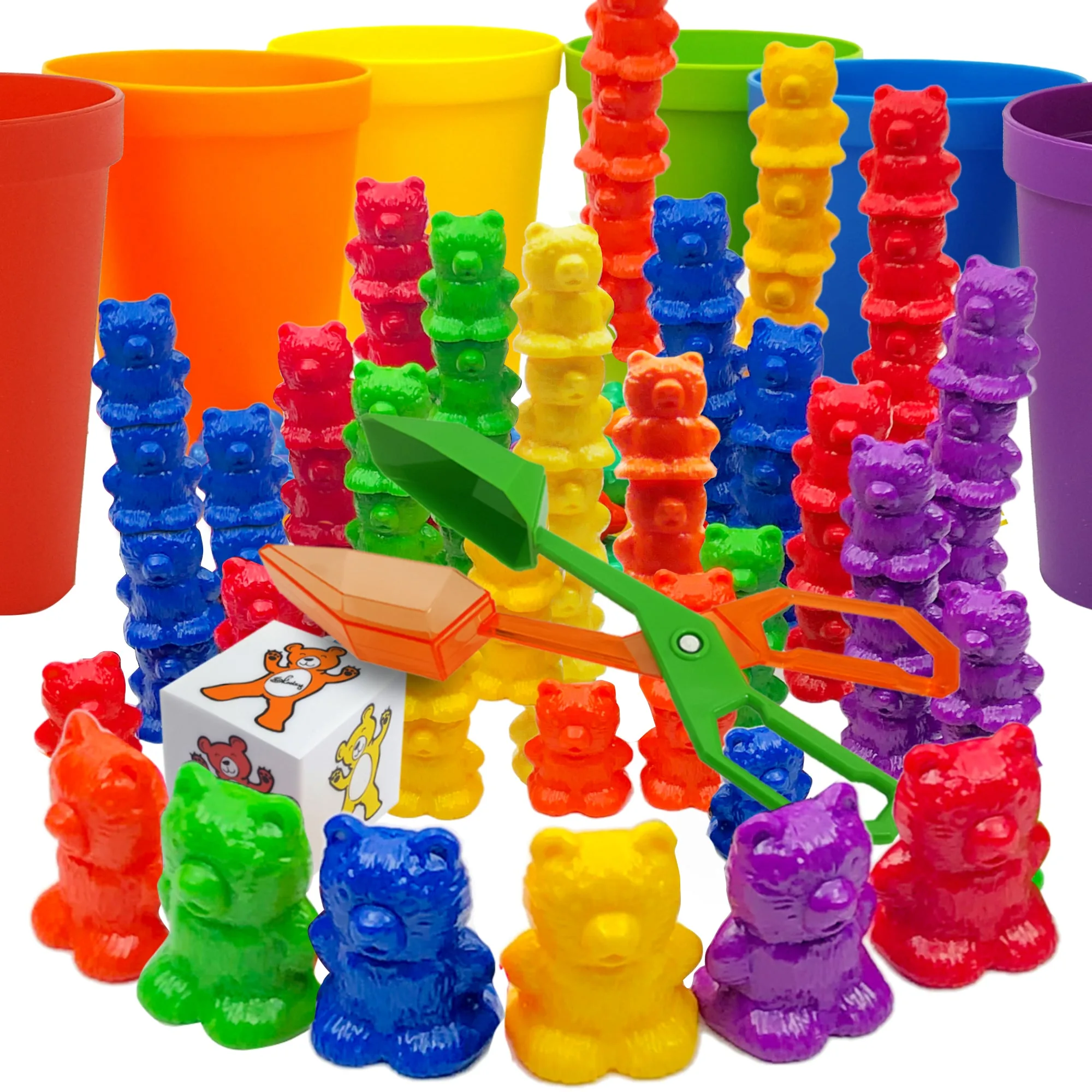
Rainbow Stacking Bears with Matching Sorting Cups 69 Piece Set, 60 Bear counters, Scissor Tongs, Rainbow Cups, Storage Bag, Sorting dice Game