Quick answer
Set up a number knockdown by standing the montessori-high-five-math-cd650a494461382d001f1c2a-1541616">Montessori High Five Math wooden blocks in a row and letting your child roll or toss a soft ball to knock them down, then count the fallen blocks together. Keep the count under five at first, say each number out loud, and let your child reset the blocks so the counting repeats naturally.
You do not need a classroom or a worksheet to teach counting. A number knockdown turns counting into a physical game your child already wants to play: knock something down, then count what fell. The repetition does the teaching.
This guide walks through a practical home setup using the Montessori High Five Math board and blocks, plus a few small adjustments that keep the activity calm, short, and repeatable.
Set up the knockdown station
Clear a low table or floor space where your child can stand and swing without hitting anything. Place the four-part wooden board from Montessori High Five Math flat as a base, then stand the 13 wooden blocks upright in a row on or beside it. Leave a gap between blocks so each one falls separately and can be counted clearly.
Keep the throwing object soft. A rolled sock, a small felt ball, or a lightweight beanbag works better than a hard ball because it knocks blocks down without scattering them across the room. If you use the double-sided flashcards, place them face down nearby so you can flip one after each round.
- Work on a rug or carpet so fallen blocks stay in one area.
- Start with three blocks, not thirteen.
Run the first round slowly
Show your child how to stand behind a line, roll or toss the soft object, and then stop. The stop matters more than the throw. Before counting, pause and look at the fallen blocks together. This is the moment where counting becomes deliberate instead of accidental.
Count each fallen block by touching it and saying the number aloud: one, two, three. Do not rush to the next round. If your child wants to knock the blocks down again immediately, say the count once more as you both reset them. Repetition in the reset is where the number sequence sticks.
- Say the number as you touch the block, not after.
- If your child counts faster than they touch, slow your own voice down.
Add the flashcards when counting is steady
Once your child can count three to five fallen blocks without skipping numbers, bring in the double-sided flashcards from the set. Flip one card after a round and ask your child to match the number of fallen blocks to the card. This links the spoken count to a written numeral, which is the next step in Montessori math at home.
Keep sessions to five or six rounds. Young children lose accuracy before they lose interest, so ending while the counting is still correct protects the habit. If your child starts guessing, stop and reset the blocks together instead of correcting the guess.
- Match cards to fallen blocks, not to standing blocks.
- End the game before accuracy drops.
Turn it into a daily ten-minute routine
A number knockdown works best as a short, predictable part of the day rather than a long lesson. Ten minutes after breakfast or before bath time is enough. The same setup, the same soft object, and the same counting voice signal to your child that this is a game, not a test.
If your child loses interest, change one variable: the number of blocks, the distance to the line, or who counts first. Do not change everything at once. A single small change keeps the counting practice familiar while giving the game just enough novelty to continue.
- Keep the same counting voice each session.
- Change one thing at a time when interest dips.
Number knockdown steps
- Set up three blocks: Stand three wooden blocks upright on the board with space between them. Place a soft ball or rolled sock behind a starting line. Checkpoint: your child can stand behind the line without stepping over it.
- Throw and stop: Let your child roll or toss the soft object at the blocks, then pause before counting. The pause is what turns knocking into counting. Common mistake: counting while the blocks are still moving.
- Count by touching: Touch each fallen block and say the number aloud together. Count only the blocks that fell, not the ones still standing. Checkpoint: your child says one number per block touched.
- Reset and repeat: Have your child stand the blocks back up and count them again as they reset. Repeat four or five rounds, then stop. Common mistake: turning the reset into a race instead of a count.
- Add a flashcard: When counting three to five blocks is steady, flip one double-sided flashcard after each round and match it to the number of fallen blocks. Next step: move to five blocks, then add a second flashcard.
Product facts that shape this activity
- Montessori High Five Math: Includes a four-part wooden board, 13 wooden blocks, and 10 double-sided flashcards; recommended for ages 3+; made from eco-friendly wood, soft felt, and card paper. The 13 blocks give you enough pieces for a knockdown row, and the flashcards let you add numeral matching once counting aloud is steady.
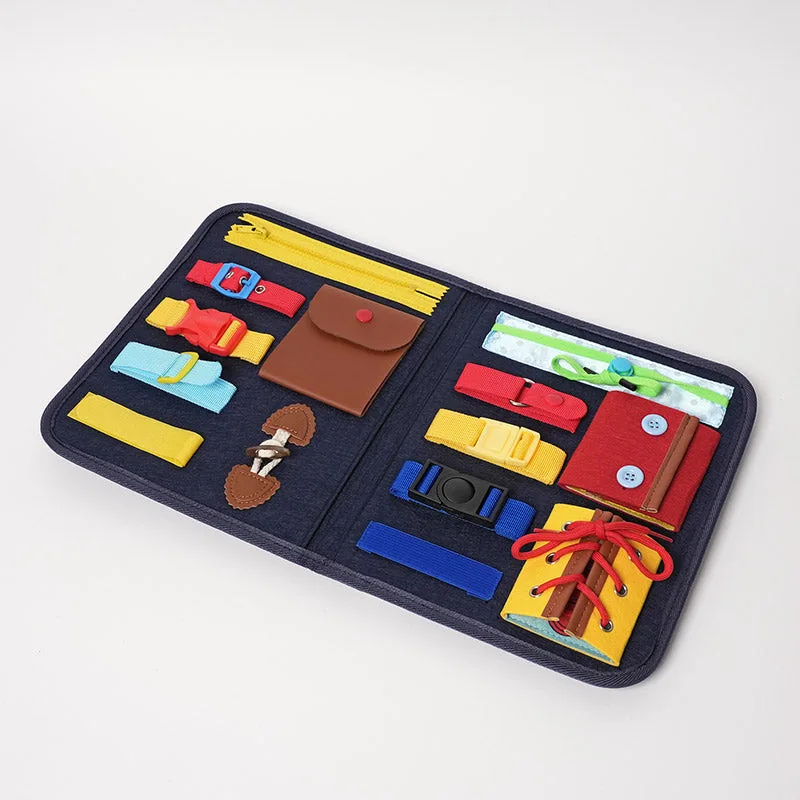
- Montessori Busy Board: Recommended for ages 2+; made from soft felt with strong bindings; designed to develop fine motor skills, hand-eye coordination, and attention span. For a younger sibling who is not ready to count, the Busy Board keeps hands busy nearby while the older child runs the knockdown game.
A number knockdown works because it makes counting physical and repeatable. Set up three blocks, throw softly, count by touching, and reset together. Keep it to ten minutes, and let the game do the teaching.