Quick answer
Square sunglasses usually fit round, oval, and heart-shaped faces best because straight lines add structure where features are soft. Round sunglasses usually fit square and rectangular faces best because curves soften a strong jaw and wide forehead. If you have an oval face, you can wear either shape, so choose based on how the frames sit on your nose and temples rather than the outline alone.
How to read your face shape before you try frames
Pull your hair back and trace your reflection with a dry-erase marker on the mirror: outline your hairline, cheekbones, jaw, and chin. If the widest point is your cheekbones and the length is clearly greater than the width, you have an oval face. If your forehead, cheekbones, and jaw are nearly the same width with a soft chin, that is round. A strong, angular jaw with similar width at the forehead reads square. A wider forehead tapering to a narrow chin reads heart.
Where round and square frames actually differ on fit
Frame shape changes three contact points: the bridge, the temple arms, and the lower rim. Round frames have a continuous curve that can slide down a narrow nose because there is less surface area gripping the sides of the bridge. Square frames have a flatter top rim and more defined corners, which can sit more securely on a low or wide bridge but may press into wide cheekbones if the frame is too deep.
Match the shape to the face, then check the sport
For running, golf, or any sweaty activity, shape matters less than grip. A square frame with a slightly wrapped back edge stays put better during quick head turns. A round frame with thin temples can bounce if the arms do not hug behind the ear. Test by looking down and shaking your head gently: if the frames shift more than a few millimeters, size down or choose a different shape.
Trade-offs: round vs. square sunglasses
- Round frames on a round face: Curves repeat curves, so the face can look softer and wider than it is. The frame may also slide if the bridge is narrow. Choose square or angular frames instead if you want more definition.
- Square frames on a square face: Straight lines repeat a strong jaw, which can look heavy. Deep square frames may also press into cheekbones. Choose round or oval frames to soften angles.
- Square frames for sport: A flatter top rim and wrapped corners usually grip better during sweat and quick movement, but they can feel bulky on small faces. Test head shakes and look-downs before committing.
Square-frame options that show how fit works in practice
- Silverback Squat Mobility: Silverback Squat Mobility is a gray active sunglass with polarized green lenses and UV400 protection, built not to slip or bounce when you sweat. The no-slip claim matters for round or oval faces that normally struggle with frames sliding during runs or golf swings.
- Underwater Thunder Plunder: Underwater Thunder Plunder is a square BFG frame with translucent teal frames and green gradient lenses, and it is designed not to slip or bounce. A square outline adds structure to soft features while the grip keeps the frame stable during high-motion activity.
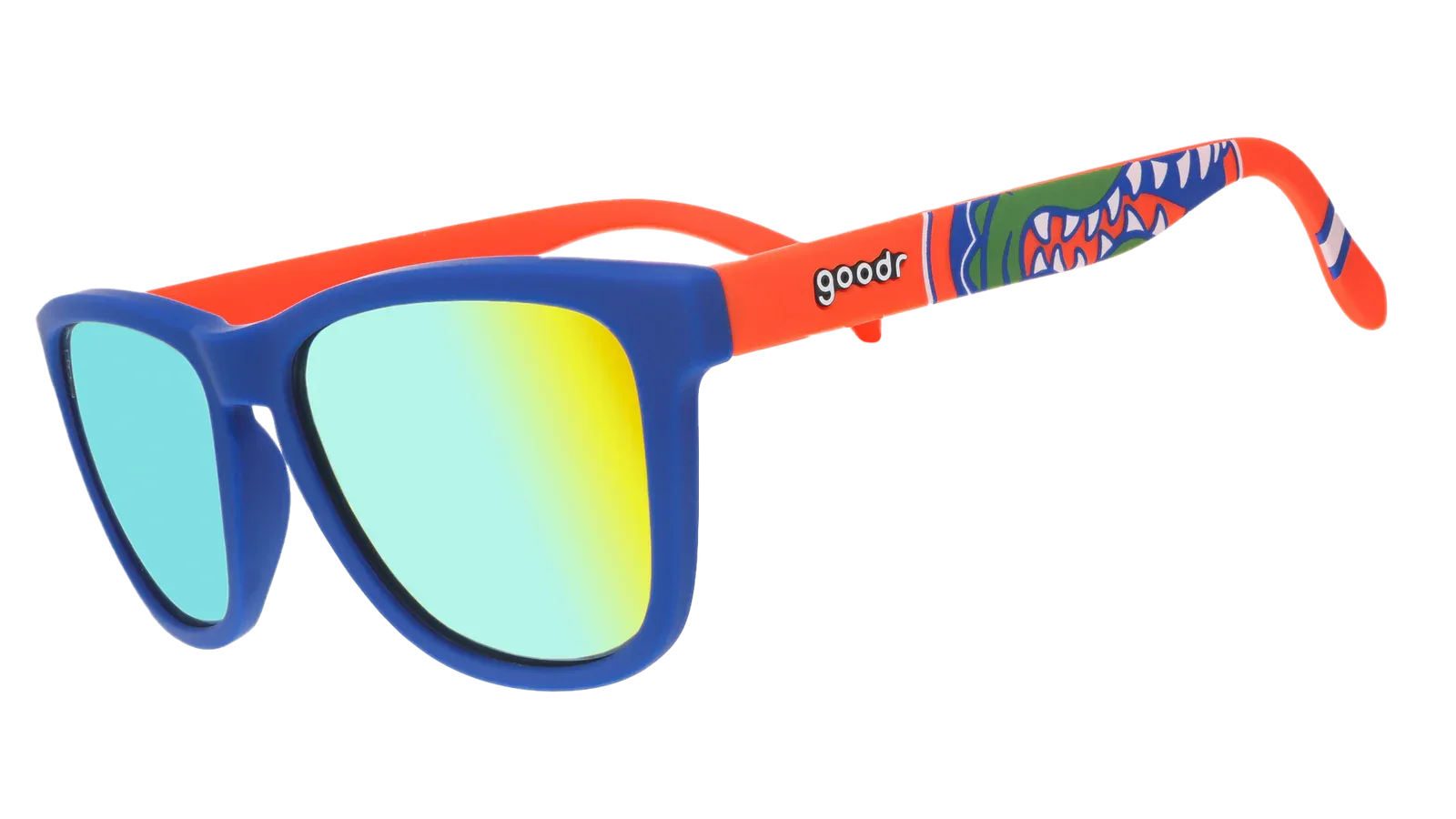
- Donkey Goggles: Donkey Goggles is a square OG frame with orange and blue coloring, polarized blue lenses, UV400 protection, and no-slip, no-bounce construction. This shows a square shape can still be lightweight and playful, which suits oval faces that want structure without a heavy look.
Which shape should you choose?
Choose square frames if you have
- a round face that needs structure
- an oval face and want a secure sport fit
- a heart-shaped face with a narrow chin
Choose round frames instead if you have
- a square or rectangular face with a strong jaw
- a very narrow bridge that needs a flatter top rim
- a preference for maximum grip during high-sweat activity