Quick Answer
A stretchy wrap is one of the coziest ways to carry a newborn, and learning the basic front-carry tie takes just a few minutes once you know the steps.
Choosing the Right Wrap Length
Most stretchy wraps come in multiple lengths to fit different body types. A wrap that is too short will be hard to tie securely, while one that is too long can leave extra fabric that feels bulky. Measure your torso or check the size chart before buying.
The Pocket Cross Carry is Best for Newborns
The pocket cross carry (also called the newborn front wrap cross carry) distributes the fabric in two layers across the baby's back and one layer across the front. This gives excellent head and neck support for a tiny newborn while keeping the wrap snug against your body.
Step-by-Step: How to Tie a Stretchy Wrap for a Newborn (Pocket Cross Carry)
- Step 1: Find the center and pre-tie the wrap: Find the center of the wrap by folding it in half lengthwise. Place the center mark on your chest, then bring the two tails behind you, cross them over your back, and bring them to the front. Tie a double knot at your waist or just above it — the wrap should feel snug but not tight. A common mistake is tying the wrap too loose. The fabric should feel like a gentle hug before you add the baby.
- Step 2: Create the pocket: Spread the front layer of fabric from your collarbone down to your waist. Then take the two crossed pieces that come from behind and spread them from your armpit to your knee on each side. This forms a pocket between the front panel and the crossed pieces. If the pocket is too low, the baby will sit too low and feel unsupported. Aim for the top of the pocket to be at your collarbone.
- Step 3: Insert your newborn: Place your baby against your shoulder, then gently slide them into the pocket, bottom first. Keep one hand on the baby's back at all times. Spread the fabric over the baby's bottom and up to their neck, making sure the fabric is smooth and not twisted. Make sure the fabric comes up to the nape of the baby's neck — never cover the baby's face or chin with fabric.
- Step 4: Tighten and check safety: Gently pull the outer layers of the wrap to remove any slack. The baby should be snug against your chest, with their knees higher than their bottom (frog-leg position). You should be able to kiss the top of the baby's head without straining. A good test: after tightening, you should not be able to pull the baby away from your body more than an inch.
Our Product Recommendation
-
"Almost Perfect" - Baby Wrap: The 'Almost Perfect' Baby Wrap is a stretchy wrap with cosmetic flaws such as misprints, small stains, or wavy seam lines, but no safety-affecting holes or flaws. If you want the same comfort and function as a full-price wrap at a lower cost, this option is safe and works exactly the same way for tying your newborn.
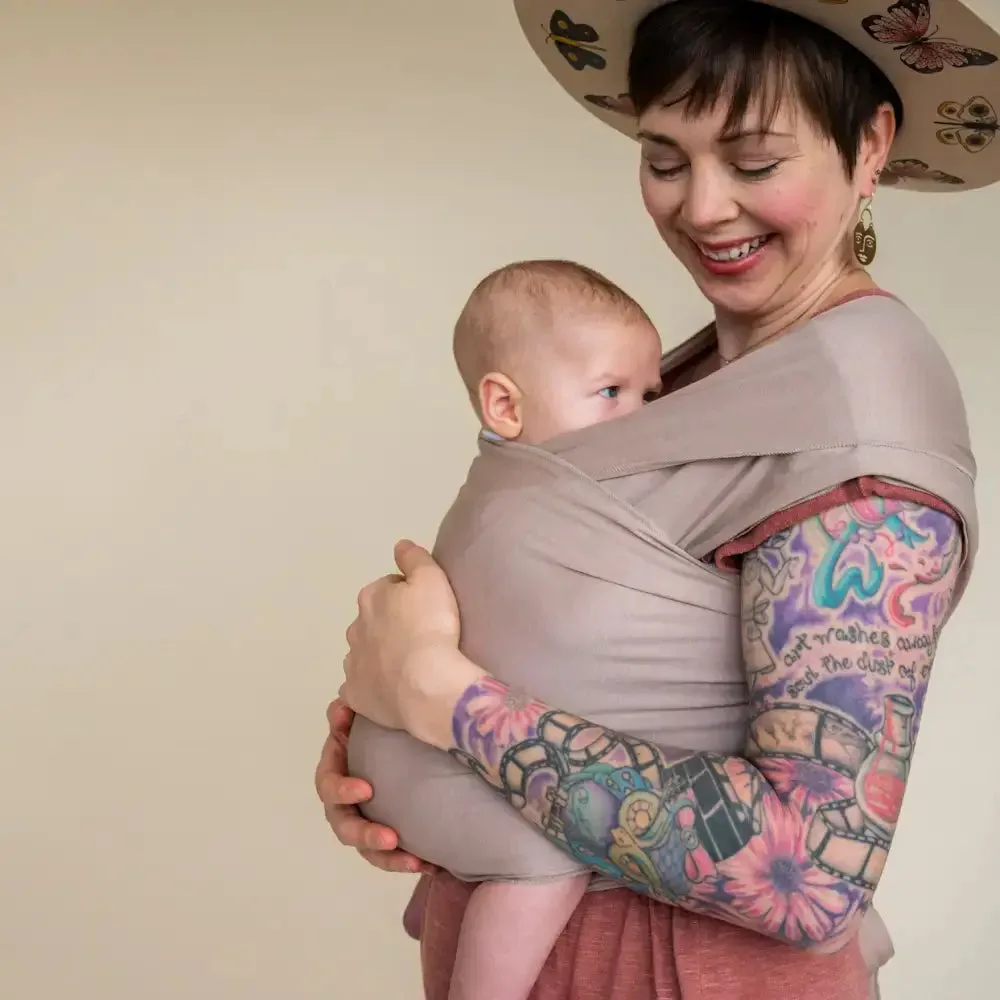
"Almost Perfect" - Baby Wrap