Quick answer
Most Damascus knife chipping comes from three things: lateral twisting on a hard board, using the edge as a scraper or scoop, and letting a fine 12° edge contact bone, frozen food, or glass. If you can see or feel a nick, hone first; if it survives honing, sharpen on a 1000-grit stone. If the chip is deeper than about 1 mm or the blade is bent, stop and send it to a professional rather than grinding away good steel.
Symptom: what a chipped edge actually looks like
A chip is a missing piece of the cutting edge, not a rolled or folded one. Under light you will see a small bright notch that catches on a fingernail dragged across the edge. A rolled edge feels rough and slightly wavy but the steel is still there; a chip feels like a tiny step or gap. The distinction matters because rolled edges respond to a honing rod in seconds, while chips need actual steel removed.
Run your thumb nail perpendicular to the edge at a shallow angle, never along the blade. If the nail snags in one spot, that is your chip. Mark it with a piece of tape on the spine so you can check progress as you work.
Cause 1: lateral force on a thin, hard edge
Damascus blades are often hardened to a high Rockwell rating, which buys edge retention but reduces toughness. That trade-off means the edge resists wear well but tolerates sideways twisting poorly. Rocking the knife left and right while the edge is buried in food, or scraping the board to scoop chopped onion, concentrates force across a very thin cross-section. The result is a small chip near the heel or belly, exactly where you pivot.
Switch to a push-cut or glide-cut and lift food with the spine or a bench scraper. If you rock-chop, keep the tip on the board and lift the heel rather than levering the blade sideways.
Cause 2: contact with hard or frozen material
Bone, frozen meat, ice, nut shells, glass, ceramic, and stone all sit well above the hardness a kitchen edge is designed to meet. A fine 12° edge, the kind hand-sharpened on steak knives and many chef's knives, is especially vulnerable because there is less steel behind the apex to support it. Trimming around a joint or separating a frozen patty is the classic way to chip a good blade.
Thaw first, cut around bone rather than through it, and keep a dedicated heavy knife for squash stems, chocolate blocks, and anything you have to force. Your Damascus blade should never be the tool you reach for when you need leverage.
Cause 3: storage and handling damage
Chips also appear between uses. A knife dropped into a drawer with other tools, left in a sink, or stacked against a plate can strike its edge against something harder. Magnetic strips and edge guards prevent most of this, but the blade must be fully dry before it goes into a guard or the moisture sits against the steel.
Wash by hand, dry immediately, and store on a strip, in a block, or in a felt-lined drawer with the edge protected. Never leave a Damascus blade soaking; the pattern is beautiful but the edge is still a cutting tool that deserves the same care as the rest of your knives.
Fix it: a three-step repair sequence
Step one is honing. Ten light passes per side on a fine rod or ceramic hone at the existing angle will often bring a shallow chip back into line by realigning the surrounding steel. Check with your fingernail after every few passes. If the snag is gone and the knife slices paper cleanly, you are done.
Step two is sharpening. If honing does not remove the snag, set a 1000-grit water stone on a stable base, match the existing bevel angle, and make slow edge-leading passes until the chip disappears. Do not increase pressure to speed this up; you are removing steel, and the chip will come out when the surrounding edge meets it. Finish with light alternating passes to restore the apex.
Step three is professional service. If the chip is deeper than roughly a millimeter, spans a large section of the edge, or the blade is bent or cracked, stop. A repair that removes that much steel changes the knife's profile and may not be worth the loss. A reputable sharpener can regrind the edge evenly or tell you honestly that the blade has reached the end of its useful life.
Preventing the next chip
The habits that prevent chipping are the same ones that keep a Damascus pattern looking sharp: cut on wood or soft plastic, never on glass or stone; use the right knife for the job; and store the blade protected. A wooden board does double duty here, cushioning the edge on impact and giving you a stable surface so the knife does not skate. If you already own a board with a juice groove, that is also the right place to rest a blade between cuts rather than laying it on a hard counter.
Check your edge monthly with the fingernail test. Catching a small chip early means a few minutes on a hone instead of a full sharpening session, and it keeps you from chasing damage that has already grown.
Diagnosis: match the symptom to the fix
- Tiny snag, edge otherwise straight: A single shallow notch that catches a fingernail but does not change the blade's line. Hone 10 light passes per side, recheck, and stop when the snag is gone.
- Visible notch after honing: The chip is still there after a full honing session, or you can see a clear missing piece of edge. Sharpen on a 1000-grit stone at the existing angle until the chip meets the new edge.
- Deep chip, bend, or crack: Damage deeper than about 1 mm, a bent blade, or a crack running into the steel. Stop sharpening and send it to a professional; heavy grinding will ruin the profile.
Products built for edge-friendly cutting
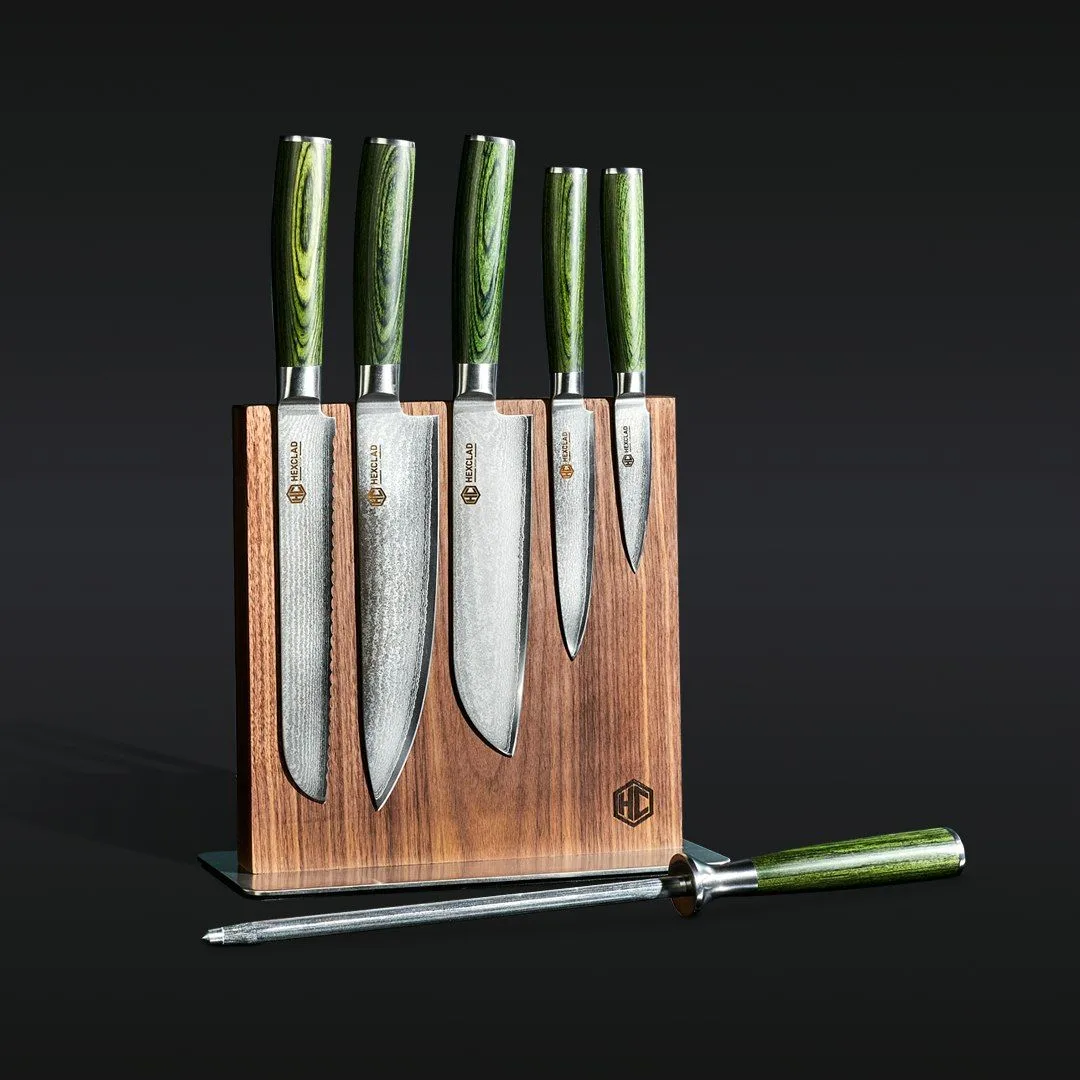
- Damascus Steel Chef's Knife, 6": Forged from 67 layers of Japanese Damascus steel with a 60 Rockwell hardness rating and a rare forest green Pakkawood handle. The 60 HRC rating explains the edge retention you enjoy and the lateral brittleness that causes chips, so treat this knife as a precision slicer rather than a cleaver.
- Damascus Steel Steak Knife Set, 4-pc (Espresso): The steak knives are hand-sharpened using the Honbazuke method to precise 12° angles. A 12° edge is thin and slicey but less tolerant of bone contact and plate scraping, so cut on the board and keep the blade off ceramic rims.
- Bistecca Plate Set, 4-pc: The Bistecca Plate Set is a wooden cutting board with a carved trough to capture juices. Wood protects high-quality knife blades and the trough keeps liquid off the edge between cuts, reducing both corrosion risk and accidental impacts.