Quick answer
Buy lids by the pan they seal, not by the width of your shelf. Match the pan's Gastronorm footprint and depth, then pick the seal style for how the pan travels: a flat Camwear lid for stacking and storage, a gasketed GripLid for soups and sauces that move, and an amber high-heat lid for freezer-to-oven work.
Start with the pan, not the lid
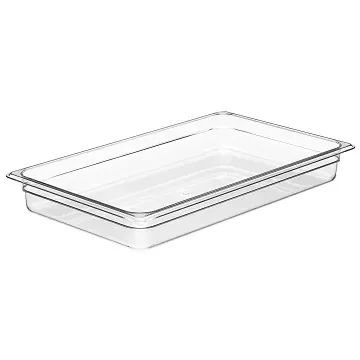
Every lid decision starts with three pan details: the Gastronorm size, the pan depth, and the material. A lid sized for a shallow pan may not seat on a deep one, and a lid molded for polycarbonate pans may not grip a stainless pan the same way.
Write those three details on a strip of tape and stick it inside the prep cabinet. When someone grabs the wrong lid, the tape answers the question faster than a catalog.
- Gastronorm size: full, half, third, or sixth size, plus the pan's letter code.
- Depth: shallow, standard, or deep pans often use different lid profiles.
- Material: polycarbonate, high-heat amber, or stainless, because each lid is molded to fit its own pan family.
How lid sizes actually match pans
Lid sizing follows the pan's Gastronorm footprint, not the lid's outside measurement. Two lids can look identical on a shelf and still fit different pans because the lip and inner shoulder are molded to a specific pan family.
If the size is not printed on the lid, measure the pan's top inside opening, not the rim. That inside measurement is what the lid's shoulder has to clear.
Seal styles and what they are worth
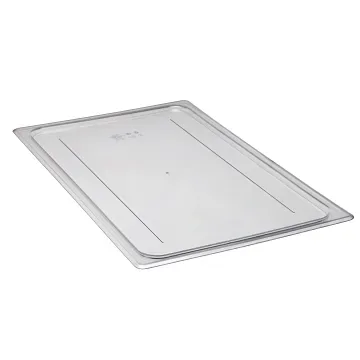
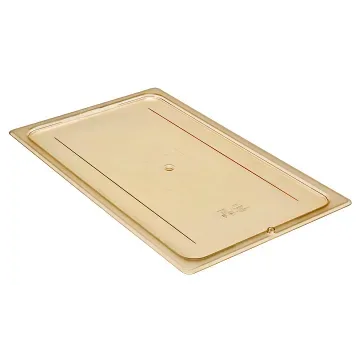
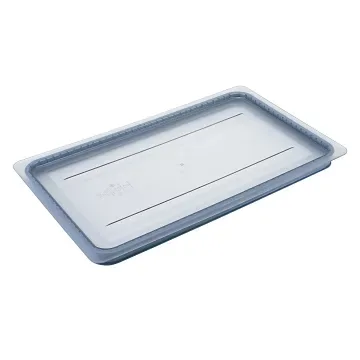
A flat lid sits on the pan and keeps dust, drips, and cross-contamination out. It is the right choice when the pan stays on a shelf or in a reach-in. A gasketed lid adds a molded-in gasket that grips the pan tightly, which matters when a pan of soup or sauce is carried across a kitchen or loaded into a transport cart. A high-heat lid trades some of that grip for temperature range, so it can go from freezer to oven without warping.
None of these seals is airtight in the vacuum-seal sense. They reduce spills, cross-contamination, and moisture loss; they do not create a sterile or oxygen-free environment.
Handles, stacking, and storage space
Handles and stacking features change how much room a pan takes up. Lids designed for stacking let filled pans sit on top of each other, which saves walk-in space but adds height. If your shelves are tight, measure the stacked height before you commit to a stacking lid.
Lids with handles are easier to lift with gloves on, but the handle adds height and can catch on shelf edges. Choose handles for hot or heavy pans, and flat lids for dense shelving.
Replacement lids: what to check before ordering
Replacement food storage lids only work if the pan underneath is still in service. Check the pan for cracks, warped rims, or a loose fit before you buy a new lid, because a damaged pan will leak no matter which lid you choose.
Order the same lid family as the pan. Mixing a lid from one material family onto a pan from another is the most common reason a new lid feels loose on arrival.
Decision rules for buying food storage lids
- Rule 1: Match the pan family first: Identify the pan's Gastronorm size, depth, and material before looking at any lid. A lid molded for a polycarbonate pan is not interchangeable with one molded for a high-heat amber pan. If you cannot name the pan family, stop and measure the pan before ordering.
- Rule 2: Let the travel decide the seal: Stationary pans in coolers and prep tables need a flat lid. Pans that are carried, transported, or stacked need a gasketed lid. Pans that go from freezer to oven need a high-heat lid. One seal style will not cover every pan in a mixed kitchen.
- Rule 3: Buy stacking only if you have the height: Stacking lids save floor and shelf space but add height to every stacked pan. Measure the shelf clearance before you standardize on stacking lids. A stacking lid that does not fit the shelf is a lid you will not use.
- Rule 4: Replace lids in sets, not one at a time: When one lid in a pan family fails, check the rest of that family. Lids wear at the same rate when they are used and washed together. Ordering a full set avoids a second shipping charge in a month.
Lids worth knowing
- Food Storage Lids: Camwear Food Pan Lids are designed to support HACCP guidelines and are intended for prep tables, reach-in refrigerators, and walk-in coolers, with options that allow space-saving stacking of food pans. If your pans mostly sit in cold storage or on a prep line, this is the straightforward flat-lid choice, and the stacking option buys back walk-in space.
- Clear Polycarbonate Food Pan GripLids®: Clear Polycarbonate Food Pan GripLids have a molded-in polyurethane gasket that grips the pan tightly, a crystal-clear top for at-a-glance inventory, and a temperature range of -40°F to 210°F. Choose these when pans of soup or sauce are carried, transported, or stacked, because the gasket is what stops the spill that a flat lid lets through.
- Amber High Heat Food Pan Lids - H-Pan™: Amber High Heat Food Pan Lids are built for freezer-to-oven flexibility, flash freezing, reheating, heated carts, buffets, and microwaves, with durable options with and without handles. If the same pan goes from the freezer into a heated cart or microwave, a high-heat lid avoids swapping lids mid-process and reduces handling.
- Food Storage Pans - Camwear®: Camwear Food Storage Pans are crystal-clear, Gastronorm designed, rated from -40°F to 210°F, and resist chemicals, at roughly half the cost of stainless steel while keeping product just as cold for just as long. Pairing the right lid with a Camwear pan keeps the whole set in one temperature range, so you are not guessing whether the lid and pan can take the same heat.
Who should buy which lid
Best for
- Prep kitchens and walk-ins that need flat, stackable lids for cold storage
- Catering and transport operations that carry soups, sauces, and dressings and need a gasketed seal
- Buffets, heated carts, and flash-freeze or reheat workflows that need a high-heat lid
Not for
- Buyers looking for a vacuum or oxygen-free seal, since these lids reduce spills and cross-contamination rather than creating an airtight environment
- Kitchens that cannot identify their pan's Gastronorm size or material, because fit cannot be guaranteed without those two details