Quick answer
To read a contact lens prescription for hyperopia, first locate the plus sign (+) before the power number—this means you need lenses that magnify to correct farsightedness. Then check the base curve and diameter to ensure a comfortable fit.
Why plus power numbers matter for hyperopia
Hyperopia, or farsightedness, means you see distant objects clearly but struggle with close-up tasks. Your prescription will have a plus sign (+) before the power number, such as +2.00. This number indicates the lens strength needed to bring near objects into focus. Unlike nearsighted prescriptions, where the number is negative, hyperopia lenses add converging power to the eye.
Key parameters beyond the power number
Besides the plus power, your prescription includes the base curve (BC) and diameter (DIA). The base curve, typically around 8.6 mm, affects how the lens sits on your eye. The diameter, often 14.2 mm, determines how much of your eye the lens covers. Getting these right is crucial because an incorrect fit can cause discomfort or blurred vision. For hyperopia lenses, the graphic diameter (the colored portion) may be smaller, like 13.7 mm, which is common for a natural look.
Step-by-step guide to reading your hyperopia contact lens prescription
- Step 1: Find the plus sign and power number: Look for a plus sign (+) followed by a number, like +1.50 or +2.75. This is your lens power for hyperopia. The higher the number, the stronger the magnification. Common mistake: confusing the plus sign with a minus sign. Always double-check the symbol before ordering.
- Step 2: Check the base curve (BC): The base curve is usually between 8.4 mm and 8.8 mm. For example, a BC of 8.6 mm is standard. If your prescription doesn't list a BC, it's often a default value that fits most eyes, but verify with your eye doctor. If the lens feels too tight or too loose, the base curve may be wrong. Consult your optometrist.
- Step 3: Confirm the diameter (DIA): The total diameter is typically around 14.0 mm to 14.5 mm. For hyperopia lenses, the graphic diameter (the colored part) is often smaller, like 13.7 mm. This ensures the color doesn't interfere with your vision. Check that the diameter matches your prescription to avoid a lens that moves too much on your eye.
- Step 4: Understand the replacement schedule and material: Hyperopia lenses come in various replacement cycles, such as 6-month lenses. The material, like silicone hydrogel, affects oxygen flow and comfort. Water content (e.g., 40%) indicates how much moisture the lens holds. Always follow the replacement schedule to maintain eye health. Don't wear lenses beyond their intended lifespan.
Product facts
-
Romantea Betty Ash Choco Hyperopia: Romantea Betty Ash Choco Hyperopia has a total diameter of 14.2 mm and a graphic diameter of 13.7 mm. This means the lens covers the entire visible eye while the colored center is slightly smaller, giving a natural appearance on brown or grey eyes.
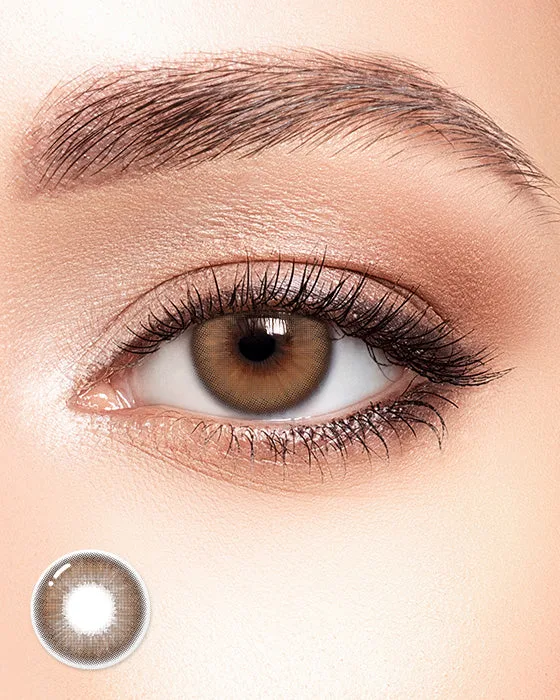
Romantea Betty Ash Choco Hyperopia
-
Romantea Sahara Sandy Black Hyperopia: Romantea Sahara Sandy Black Hyperopia has a base curve of 8.6 mm and a water content of 40%. A standard base curve ensures a stable fit for most eyes, and the silicone hydrogel material provides good oxygen permeability for comfortable all-day wear.
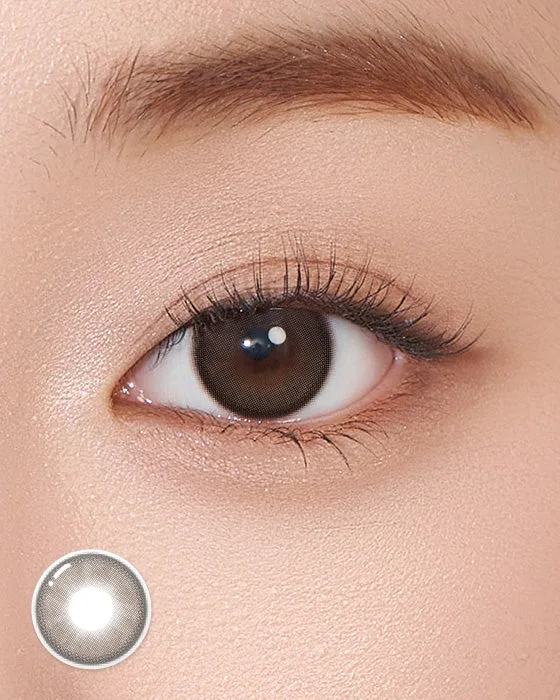
Romantea Sahara Sandy Black Hyperopia