Quick Answer
In Locus, players flip shape cards, draft polyomino tiles, and write them onto their grid to score points in different colored zones. The player with the highest total after several rounds wins.
What Makes Locus Different from Other Flip-and-Write Games
Unlike many roll-and-write games, Locus uses a flip-and-draft mechanic where players reveal a set of shapes each round, then take turns choosing the one that best fits their grid. This adds a layer of player interaction and strategic denial. Because you cannot rotate or mirror shapes after placing them, planning ahead is critical.
The game also features distinct scoring zones and colors that reward different placement strategies. A shape that scores well in one zone might be worthless in another, forcing you to balance immediate gains with long-term grid efficiency.
How to Play Locus: Step-by-Step Rules
- Set Up Your Grid and Scoring Zones: Each player gets a grid sheet with several colored scoring zones. Shuffle the shape cards and place them face down in a draw pile. Give each player a dry-erase marker. Make sure everyone understands which color zones score what way before starting.
- Flip and Draft Shapes: Reveal a number of shape cards equal to the number of players. Starting with the first player, each player chooses one shape and writes it onto their grid. Shapes can be rotated or mirrored freely before placement. A common mistake is taking a shape that fits now but blocks a high-scoring zone later. Always check future space.
- Place the Shape on Your Grid: Draw the chosen polyomino shape into any empty cells on your grid. Shapes cannot overlap or extend beyond the grid boundaries. Once written, the shape is locked in place. Double-check orientation before writing. Erasing and redrawing is messy and wastes time.
- Score at the End of Each Round: After all players have placed their shapes, calculate round scores based on how each shape touches the scoring zones. Some zones award points per cell, others for completing rows or patterns. Keep a running tally to track who is ahead. This helps you decide whether to play aggressively or defensively.
- Play Multiple Rounds and Declare the Winner: The game consists of a set number of rounds (usually 5-8). After the final round, add up all round scores. The player with the highest total wins. If there is a tie, the player with the most completely filled zones wins.
Product Details
-
Locus: In Locus, each round players reveal a set of shapes, then take turns drafting the one that best fits their grid. This means you must adapt your strategy based on what shapes are available, not just follow a preset plan.
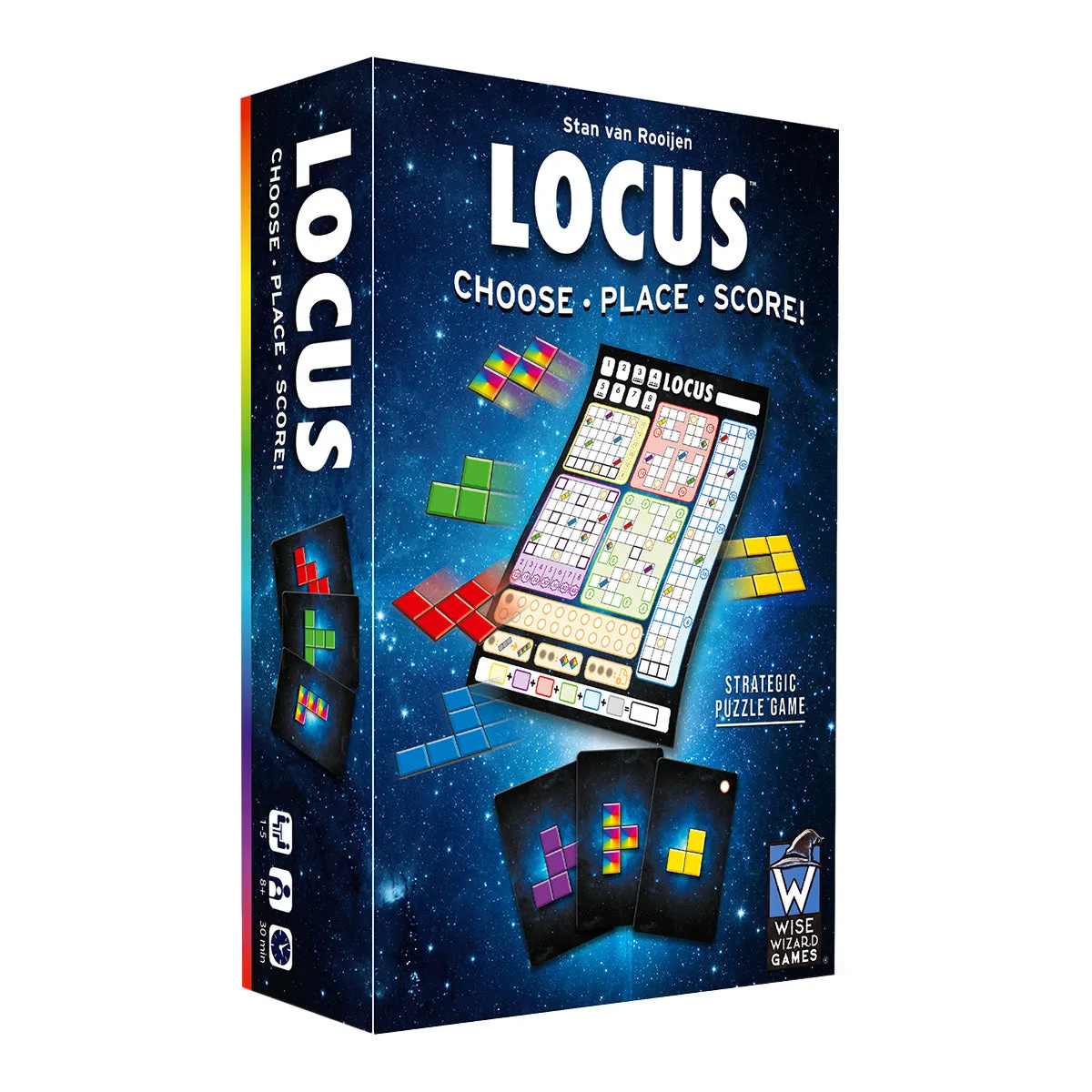
Locus