Quick answer
The scoop in your tub is not a universal measurement. Use the Nutrition Facts label as your authority: find the serving size in grams, then weigh that amount on a kitchen scale for the most consistent result. If you do not have a scale, use the scoop that came with that exact product and level it off—never assume a scoop from another brand equals the same serving.
Why scoop sizes differ from tub to tub
A protein scoop is a convenience tool, not a standard unit. Brands size their scoops to deliver their own label serving, so a scoop from one product can hold noticeably more or less powder than a scoop from another. That is why two people can both say they had 'one scoop' and end up with very different amounts of protein.
The practical fix is to treat the label as the source of truth. The serving size line tells you the gram weight the nutrition numbers are based on. If you want your shake to match the label, you need to match that weight—not the volume of whatever scoop is in the tub.
How to measure protein powder without a scale
If you do not own a kitchen scale, you can still get close by using the scoop that shipped with the product and leveling it. Scoop powder loosely into the scoop, then sweep a knife or the back of a spoon across the top to remove the mound. A packed or heaped scoop can hold meaningfully more powder than a level one, which is the most common measuring mistake.
Keep in mind that leveling gets you consistency, not precision. If you switch products or want to track intake closely, a scale is the better long-term tool.
Adjusting your portion for your goals
Once you know the label serving, you can decide whether to use it as-is or adjust. A full serving is a straightforward starting point for a post-workout shake or a meal replacement. If you are using protein powder as a smaller snack or adding it to a recipe, you might prefer a half serving—just measure by weight or by a level half-scoop rather than eyeballing it.
If you are combining protein powder with other ingredients, remember that the powder's serving is only one part of the total. A shake with milk, yogurt, or nut butter adds protein and calories beyond the scoop, so account for those if you are tracking.
What to do when the scoop is missing
Scoops go missing, and some products do not include one at all. In that case, the label is still your guide: use a kitchen scale to weigh the gram serving, or use a measuring spoon only as a rough starting point and adjust based on how the shake tastes and mixes. Do not substitute a scoop from a different brand and assume it matches—scoop volumes are not interchangeable.
If you regularly use a product, it helps to note the gram serving somewhere you will see it, like a note on the tub or in your phone, so you are not re-checking the label every time.
Step-by-step: measuring a protein powder serving
- Find the serving size in grams: Look at the Nutrition Facts panel and note the serving size, which is listed in grams (and sometimes also in scoops). This is the amount the protein, calories, and other numbers are based on. Checkpoint: if the label only lists '1 scoop' without grams, treat the gram weight as unknown and use a scale to find what one level scoop of that product actually weighs.
- Use the scoop that came with the product: Scoop powder loosely and level it off with a straight edge. Avoid tapping the scoop to settle more powder in, and avoid packing it down—both increase the amount beyond a level scoop. Common mistake: using a heaped scoop and calling it 'one scoop.' A heaped scoop can deliver more powder than the label serving.
- Weigh the powder for accuracy: Place your shaker or a small bowl on a kitchen scale, zero it out, and add powder until you reach the gram serving from the label. This is the most reliable way to match the label, especially if you switch between products. Checkpoint: if the weight is consistently higher or lower than the label with a level scoop, your scoop may not match the label serving—trust the scale.
- Adjust the portion to your goal: Use the full label serving for a standard shake, or measure a half serving by weight if you want a lighter snack or you are adding protein powder to a recipe. Keep the ratio consistent so your results are repeatable. Next step: if you use the same product often, write the gram serving on the tub or save it in your phone so you do not have to re-check the label each time.
Product facts to keep in mind
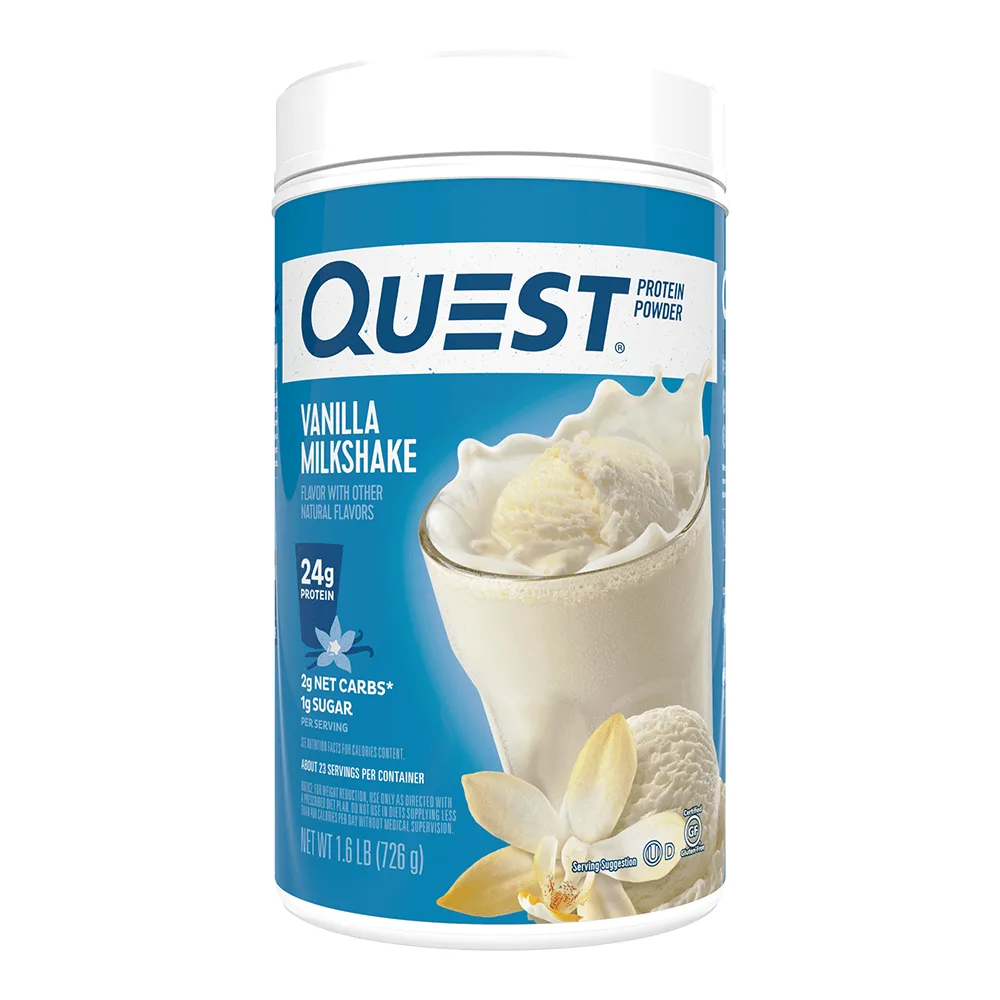
- Vanilla Milkshake Protein Powder: Quest Nutrition https://questnutritionshop.com/products/vanilla-milkshake-protein-powder-38377https://questnutritionshop.com/products/vanilla-milkshake-protein-powder-38439Vanilla Milkshake Protein Powder is available in multiple pack sizes: 1.6 lb. canister, 3 lb. canister, 3 x 1.6 lb. canister, and 2 x 3 lb. canister. If you buy a larger pack, the scoop inside may be the same size, but the tub lasts longer—so it helps to confirm the label serving once and then use that same scoop consistently.
- Protein Shake Variety Pack: The Protein Shake Variety Pack includes 6 individual items for grab-and-go nutrition. Pre-portioned shakes remove the scoop question entirely, which is useful when you want a consistent serving without measuring powder yourself.