Quick answer
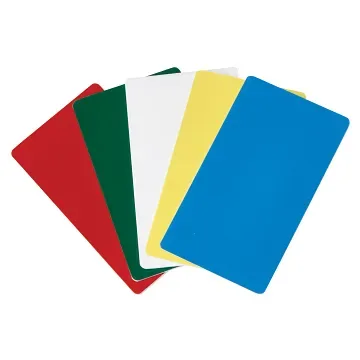
Print four things on every food storage label: the contents, the prep or open date, the use-by date, and the initials of the person who prepped it. Use a simple label like Cambro ID Labels when you need a consistent, pre-printed format that staff can fill in quickly, and reserve printed date labels for high-turnover items where rotation speed matters most.
What should actually go on a food storage label?
A working label answers four questions at a glance: what is inside, when it was made or opened, when it must be used by, and who is accountable. Contents come first because it is the fastest way to prevent mix-ups between similar-looking sauces, dressings, or proteins. The prep or open date tells you where the item sits in rotation. The use-by date tells you when to pull it. Initials create accountability without needing a full signature.
If your kitchen uses a standardized label format, staff stop improvising with tape and marker, which is where most labeling gaps start. A pre-printed label with dedicated fields for each of those four items is faster to complete than a blank sticker and easier for a manager to audit at a glance.
How do date labeling rules differ for containers versus food pans?
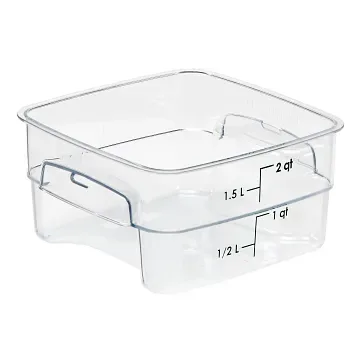
Containers and pans create different labeling problems. Square storage containers like Camsquares FreshPro sit on shelves and in coolers, so the label needs to survive cold, moisture, and repeated handling without peeling. Food pans move through hotter stages, so the label has to hold up when the pan goes from prep to a steam table or oven.
The practical rule is to match the label to the surface and the temperature range, not just the food. On a pan that sees high heat, place the label where it will not sit directly against a heating element or under a lid that traps steam. On a cold storage container, place it on a flat face rather than a curved corner so it stays readable when containers are stacked.
Should you use printed date labels or handwritten ones?
Handwritten labels are flexible and cheap, but legibility varies by person and shift. Printed date labels produce consistent text that anyone can read, which matters most for items with short shelf lives and for kitchens running multiple shifts. The tradeoff is that printed labels are less adaptable when you change a recipe or a use-by window on the fly.
A workable middle ground is to use a pre-printed label with blank fields for contents and dates, then write in the specifics. That gives you the structure of a printed label with the flexibility of handwriting. Cambro ID Labels follow this approach: they are designed for marking and identifying food storage containers so labeling stays consistent across the team.
Where should labels go on containers and pans?
Put the label where it will be seen first. On a stacked container, that means the front-facing side, not the lid, because lids get swapped and stacked containers hide the top. On a food pan in a steam table or display, the label should face the service side so staff can read it without lifting the pan.
Avoid placing labels where they will be submerged in liquid, scraped by utensils, or covered by another container. If a container gets washed and reused, remove the old label before applying a new one so dates do not stack up and create confusion.
How do labels fit into a food rotation system?
Labels only work if they feed a rotation habit. The simplest system is first-in, first-out: new items go behind or below older ones, and the label date tells you which is which. Without a date on the label, staff have to guess, and guessing is where rotation breaks down.
Keep the labeling step physically close to where containers are filled. If labels live in a drawer across the kitchen, they get skipped during a rush. A roll or sheet within arm's reach of the prep station is the difference between a system that runs and one that only exists on paper.
Food storage labeling FAQ
What are the four must-have fields on a food storage label?
Contents, prep or open date, use-by date, and the initials of the person who prepped the item. If any of the four is missing, the label cannot support rotation or accountability.
Do I need different labels for cold storage and hot pans?
The label format can be the same, but placement should change. Keep labels off surfaces that see direct heat or trapped steam on high-heat pans, and place them on a flat, front-facing side on cold storage containers. Match placement to the temperature path, not just the container type.
Are pre-printed labels better than handwritten ones?
Pre-printed labels win on legibility and consistency across shifts. Handwritten labels win on flexibility for one-off items. A pre-printed label with blank fields for contents and dates covers both needs. Choose the format that your team will actually complete during a rush.
How often should labels be replaced?
Replace the label every time the container is refilled, and remove the old label first so dates do not stack. A container that has been washed should get a fresh label before it goes back into rotation. Old labels left in place are the most common source of date confusion.
Where should labels be stored in the kitchen?
Keep them within arm's reach of the prep station where containers are filled, not in a separate office or storage room. Distance is the main reason labeling steps get skipped.
Product facts
- ID Labels: Cambro ID Labels are designed to help you clearly identify and organize your food storage containers, and they are available in a standard option. A consistent pre-printed label format makes it easier to keep labeling practices uniform across shifts instead of relying on whatever tape or marker is nearby.
- Camsquares® FreshPro Food Storage Containers – Camwear®: Camsquares FreshPro Food Storage Containers are made from durable Camwear material, and their square design fits neatly into standard shelving and refrigerators. Flat, stackable square containers give you a stable surface for labels and make it easier to keep dated items visible and organized on the shelf.
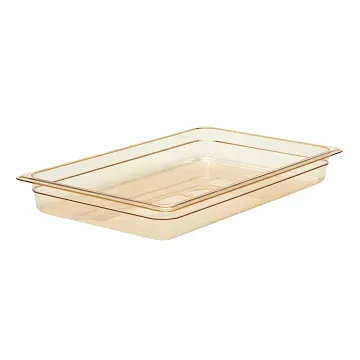
- Amber High Heat Food Pans - H-Pan™: Amber High Heat Food Pans are rated to perform from 40°F to 375°F (-40°C to 190°C), so they can go from prep to cooler to oven and then to service. Because these pans move through multiple temperature stages, label placement matters more than on a container that stays cold, so keep labels away from direct heat and trapped steam.