Quick answer
Measure your underbust snugly and your full bust at the fullest point, then use the difference to find your cup size. Before birth, add one cup size if your breasts are still growing; after milk comes in, remeasure at least once. Recheck every 4–6 weeks because maternity bra size changes are normal. Choose a band that fits on the loosest hook so you can tighten it as the band relaxes.
Why nursing bra sizing changes before and after birth
Your ribcage and breasts change at different speeds during pregnancy and after delivery. Before birth, the band size may expand as your ribs flare, while the cup size can increase by one or more sizes. After milk comes in, the cup size often jumps again, then settles over several weeks. This is why a single measurement is not enough. A nursing bra that fits well in month seven may feel tight or loose by month nine, and a bra that fits on day three postpartum may not fit on day twenty-one.
For a full-bust nursing bra, the band provides most of the support, so a band that is too loose will let the cups ride up and cause shoulder strain. A band that is too tight can dig into your ribs and restrict breathing. The goal is a snug band that stays level all the way around, with cups that fully contain your breast tissue without spilling or gaping.
How to measure your nursing bra size step by step
Use a soft measuring tape and wear an unlined, non-padded bra or no bra. Stand in front of a mirror so you can keep the tape level. Write down your measurements each time because your size will change. If you are measuring before birth, measure at the end of the day when your breasts are fullest. If you are measuring after birth, measure after a feeding or pumping session if possible, so your breasts are not engorged.
- Step 1: Measure your underbust. Wrap the tape snugly around your ribcage, directly under your breasts. Keep the tape level and exhale normally. Round to the nearest whole inch. If the number is even, add 4 inches; if odd, add 5 inches. This is your band size. Common mistake: pulling the tape too tight or letting it slip down your back.
- Step 2: Measure your full bust. Wrap the tape around the fullest part of your breasts, usually across the nipple line. Keep the tape parallel to the floor and do not compress your breast tissue. Round to the nearest whole inch. Common mistake: measuring over a padded bra or pulling the tape too loose.
- Step 3: Find your cup size. Subtract your band size from your full bust measurement. Each inch of difference equals one cup size: 1 inch = A, 2 = B, 3 = C, 4 = D, 5 = DD/E, 6 = DDD/F, 7 = G, 8 = H. Common mistake: using your pre-pregnancy cup size as a starting point instead of measuring fresh.
- Step 4: Adjust for nursing. If you are still pregnant and your breasts are growing, add one cup size to your current measurement. If your milk has come in, measure after feeding and use that size. Common mistake: buying a bra that fits only on the tightest hook; you need room to tighten the band as it stretches.
- Step 5: Try the bra on and check the fit. Fasten the band on the loosest hook. The band should be snug but not painful, and it should not ride up when you lift your arms. The center gore should lie flat against your sternum. The cups should contain all your breast tissue without quad-boob or gaping. Common mistake: ignoring the band if the cups feel right; most support comes from the band.
When to remeasure after birth
Remeasure at least once after your milk supply regulates, usually around 4–6 weeks postpartum. Many people need a second size shift between 6 and 12 weeks. After that, check your fit every 4–6 weeks for the first six months, then every few months. If you return to your pre-pregnancy band size but your cup size stays larger, that is normal. Use your current measurements, not your old size.
If you are between sizes, size up in the band and down in the cup, or choose a bra with a stretchy band and adjustable straps. A bra with a pocket insert for nursing disks can help with leakage, but it does not change your size. Always prioritize a comfortable band and full cup coverage over a specific number.
Underwire nursing bra sizing: what to check
Underwire nursing bras can be supportive if the wire sits flat against your ribcage and does not press on breast tissue. The wire should follow your natural breast root, not sit on top of it. If the wire digs into your ribs or armpit, the band or cup size is wrong. A seamless cup design can be more forgiving if your size is fluctuating, because it stretches with you. If you are unsure, start with a wireless style until your size stabilizes, then switch to underwire.
Your nursing bra sizing checklist
- Measure underbust: Wrap the tape snugly under your breasts, keep it level, and exhale. Add 4 inches for an even number, 5 for an odd number. Checkpoint: the tape should not leave red marks or slide down your back.
- Measure full bust: Wrap the tape around the fullest part of your breasts without compressing tissue. Round to the nearest inch. Checkpoint: the tape stays parallel to the floor.
- Calculate cup size: Subtract band size from full bust. Each inch equals one cup size (1=A, 2=B, 3=C, 4=D, 5=DD/E, 6=DDD/F, 7=G, 8=H). Checkpoint: if you are pregnant and still growing, add one cup size.
- Try on and adjust: Fasten on the loosest hook. The band should be snug and level, the center gore flat, and cups should contain all tissue without spillage. Checkpoint: if the band rides up, go down a band size and up a cup size.
- Remeasure after birth: Measure again 4–6 weeks postpartum and every 4–6 weeks for the first six months. Use current measurements, not pre-pregnancy size. Checkpoint: if you are between sizes, size up in the band and down in the cup.
Product facts that help with sizing
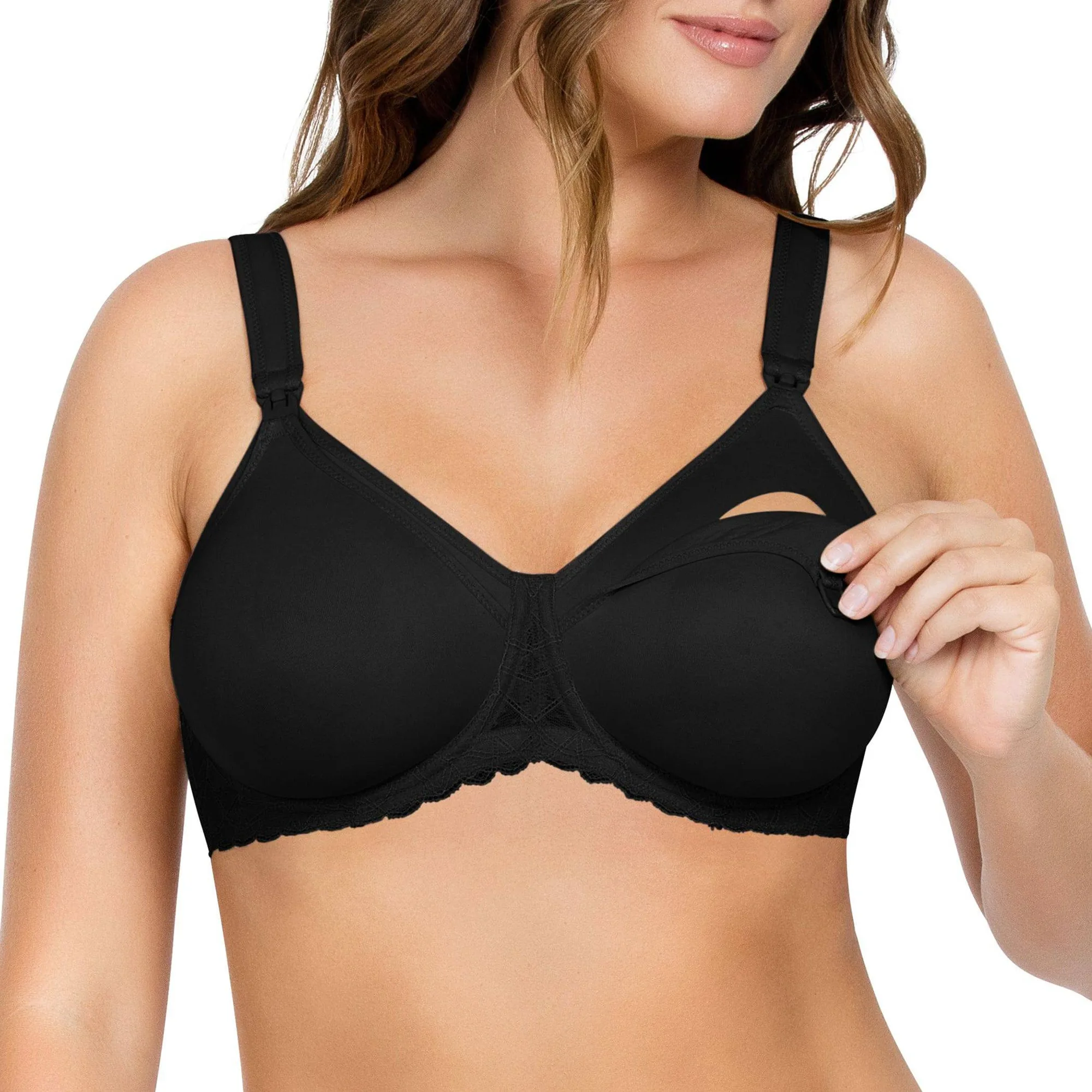
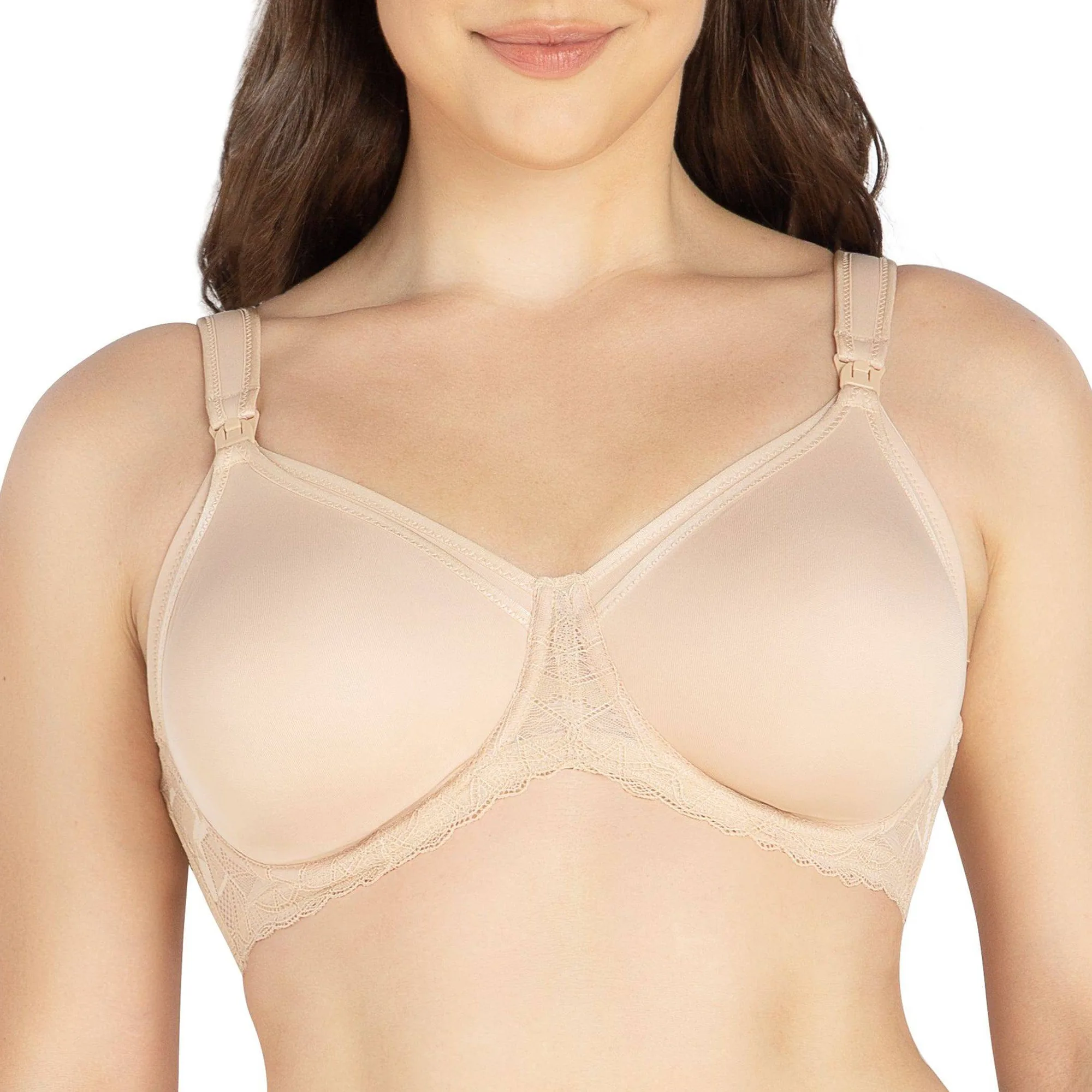
- Leila Underwire Full Bust Nursing Bra - Bare: Seamless cup design, sturdy snap that unhooks with one hand, pocket insert for nursing disks, padded straps, and 80% nylon / 20% spandex. The seamless cup stretches with size changes, and the one-hand snap is useful during feeding. The pocket insert adds leakage protection without changing fit.
- Shea Full Bust Unlined Plunge Bra - Petal Pink: 3-part underwire cup with external and internal side slings, comfort striped stretch mesh at the side, back and neckline, and a plunge neckline. The side slings and stretch mesh can help if you need extra support and ease of fit, especially when your size is still changing.