Quick answer
Every griddle has hotter and cooler areas, even when the burners are set the same. Map those zones with an infrared thermometer, then match each food to the right spot: sear burgers and bacon over the hottest zone, cook eggs and pancakes in the cooler zone, and use the middle band for foods that need steady heat. This lets you cook a full breakfast or dinner on one surface without burning anything.
Why griddle temperature zones matter
Griddles are not uniform cooking surfaces. The area directly above each burner runs hotter, the edges and corners run cooler, and heat spreads unevenly across the plate. On a two-burner griddle, you get at least two hot zones plus a cooler center strip. On larger models, the pattern repeats across the surface. Knowing where those zones are turns a single griddle into several cooking areas you can use at once.
The practical payoff is timing. If you cook everything in the same spot, you either burn the delicate food or undercook the dense food. By moving food between zones, you can sear a burger on high heat, then slide it to a cooler spot to finish without drying out. You can also keep finished food warm on the coolest edge while you cook the rest.
How to map your griddle's zones
Preheat the griddle on medium for 10 to 15 minutes with the lid open. Then use an infrared thermometer to scan the surface in a grid pattern, about every 4 to 6 inches. Write down the temperature at each point. You will quickly see the hot spots, the cool spots, and the transition areas.
Repeat the scan at low and high settings. The pattern stays roughly the same, but the spread between hot and cool widens at higher settings. A zone that reads 350°F on medium might hit 450°F on high, while the cool corner might only rise 50°F. That spread is what gives you cooking flexibility.
Matching foods to zones
Use the hottest zone for quick searing: burgers, steaks, bacon, and smash patties. The intense heat creates a crust fast. Use the middle zone for foods that need to cook through without burning: pancakes, French toast, grilled sandwiches, and vegetables. Use the coolest zone for delicate items like eggs, or as a holding area for finished food.
If your griddle has independently controlled burners, you can also create zones by setting different dial positions. For example, run the left burner on high for searing and the right burner on low for eggs. That gives you a wider temperature range than any single setting can produce.
Step-by-step: cook with griddle temperature zones
- Preheat and scan: Turn the griddle to medium and let it heat for 10–15 minutes. Use an infrared thermometer to check the surface temperature every few inches. Write down the hottest and coolest readings. Checkpoint: if the temperature varies by more than 100°F across the surface, you have distinct zones to work with.
- Mark your zones: Mentally divide the griddle into three bands: hot (directly over burners), medium (between burners), and cool (edges and corners). If your griddle has two burners, you can also set one side higher than the other. Common mistake: assuming the center is always the hottest spot. On many griddles, the edges are actually cooler than the center, but the hottest point is directly above each burner.
- Start food on the hot zone: Place items that need a quick sear—burgers, bacon, steaks—on the hottest area. Let them sit undisturbed for 2–3 minutes to develop a crust before flipping. Checkpoint: if the food is smoking heavily or burning within a minute, your hot zone is too hot. Reduce the burner setting slightly.
- Move to the medium zone to finish: After searing, slide burgers or thick cuts to the medium zone to cook through without burning the outside. This is also where you cook pancakes, eggs, and vegetables from the start. Common mistake: leaving food on the hot zone for the entire cook time. That causes burnt exteriors and raw centers.
- Use the cool zone for delicate foods and holding: Cook eggs, melted cheese, or thin fish in the coolest area. You can also park finished food there to stay warm while you cook the rest. Checkpoint: the cool zone should still be hot enough to keep food warm (above 140°F) but not so hot that it continues cooking quickly.
- Clean and re-oil between batches: Scrape the surface and apply a thin layer of oil before cooking the next batch. This prevents sticking and keeps zone temperatures consistent. Common mistake: skipping the scrape. Burnt bits on the surface create hot spots that can burn the next batch.
Tools that help you find and use your zones
- Infrared Thermometer: Measures surface temperatures from –58°F to 932°F with a laser pointer and digital display. Lets you scan your griddle surface and identify hot and cool spots in seconds, so you can place food accurately instead of guessing.
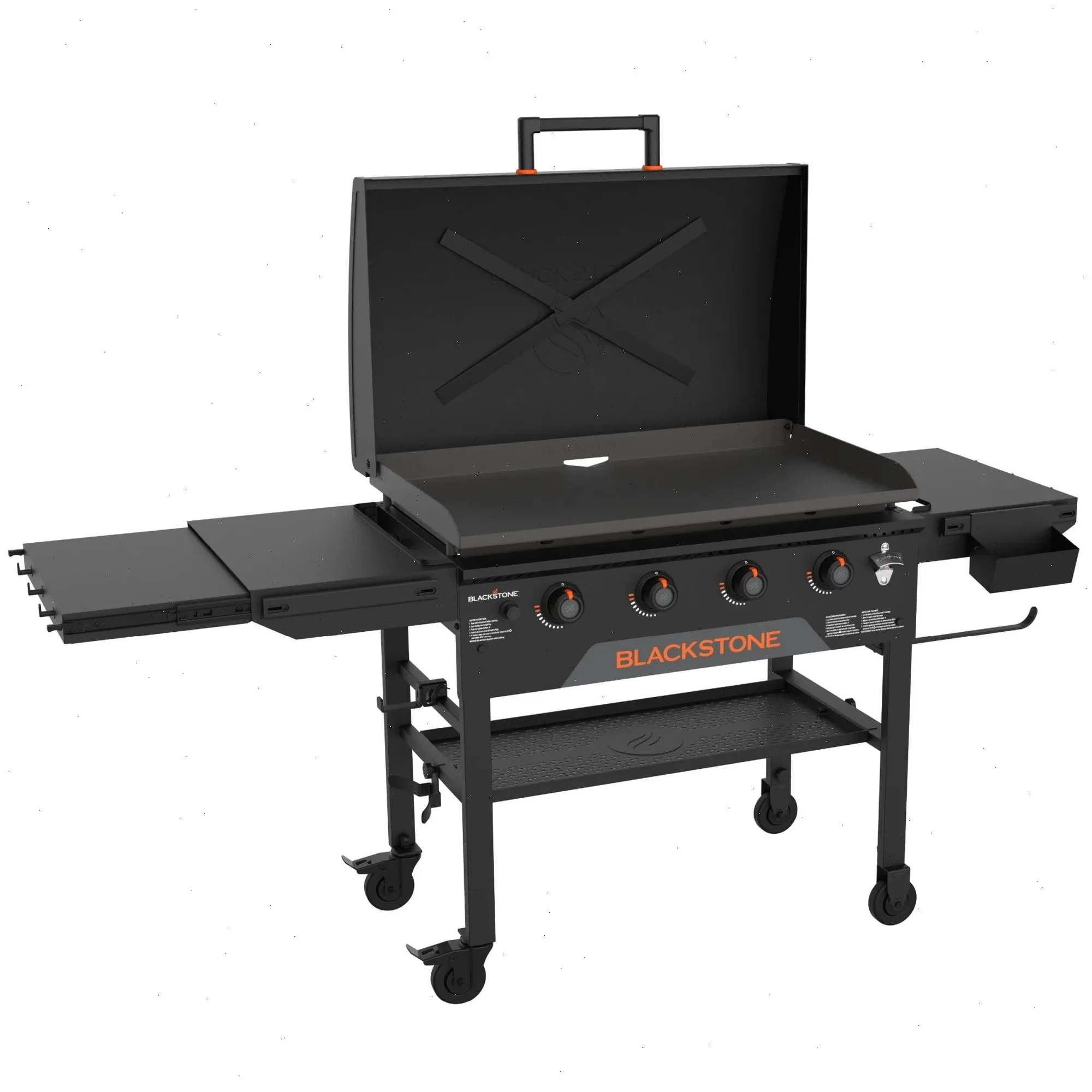
- 28" Griddle with Hood: Two independently controlled cooking zones with 34,000 BTU's and dual stainless H burners. Independent burner control lets you set up a hot zone and a cool zone at the same time, which is the core of zone cooking.